ISBN and barcode are two of the most commonly confused terms in self publishing, and getting either wrong can block your book from bookstore shelves, library systems, and retailer databases. They are related but not the same thing, and whether a book needs an ISBN has a different answer depending on where and how you are selling.
This confusion matters because the decision you make about your book ISBN and barcode directly affects your publishing identity, your distribution options, and whether your book is properly discoverable by booksellers, librarians, and readers.
Your options: use a free ISBN from Amazon KDP (quick but limiting), purchase your own ISBN from Bowker (the US ISBN agency), or have your publisher assign one. For authors serious about distribution beyond Amazon, owning your own ISBN is the right move. Quill Forge Publishing handles ISBN acquisition and barcode generation as part of our book publishing services. Call +1 (512) 380-1661 to learn more.
What Is an ISBN, and What Does Book ISBN and Barcode Actually Mean?
An ISBN (International Standard Book Number) is a 13 digit identifier unique to a specific edition of a book. It is the universal language of the book trade, used by publishers, distributors, booksellers, libraries, and databases worldwide to identify your title.
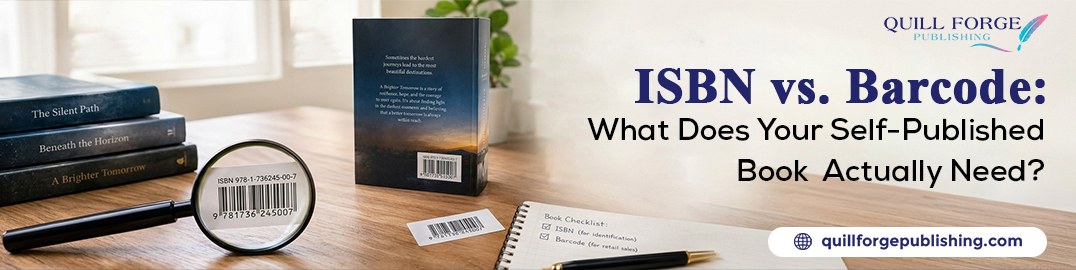
A barcode is the visual, machine readable representation of that number. It is the striped image printed on the back cover that a cashier or warehouse scanner reads at point of sale. The barcode encodes the ISBN (and often the price) in a format scannable at retail.
The key distinction:
-
ISBN = the identifier. It lives in databases. It tells systems who published the book, what edition it is, and how to order it.
-
Barcode = the physical representation. It lives on the back cover. It lets retail systems scan the ISBN at point of sale.
You need both for physical retail. For ebook only distribution, the ISBN is still valuable for discoverability, but a barcode is irrelevant since there is no physical cover to print it on. For a full walkthrough, read how to get a US ISBN for your self published book.
Does a Book Need an ISBN? Is It Actually Required?
It depends on where you are selling.
The short answer: if you are selling only Amazon ebooks, you can technically skip an ISBN. For self published books that will ever appear in a bookstore, library, or any retailer outside Amazon, an ISBN is nonnegotiable. Not sure which platform fits? Compare IngramSpark vs KDP before you decide.
What Is the Difference Between a KDP Free ISBN and Your Own ISBN?
Amazon KDP offers a free ISBN for paperback books published through their platform. It is convenient, but it comes with a significant limitation that many authors discover too late. Here is a closer look at free KDP ISBN vs your own ISBN and what it really costs you.
KDP free ISBN:
-
Publisher of record is listed as “Independently published” in all databases
-
Cannot be used outside Amazon, so you cannot list the same ISBN on IngramSpark or any other distributor
-
No branding, since your publishing entity does not exist in industry databases
-
Limits your ability to distribute to bookstores and libraries effectively
Your own ISBN (purchased through Bowker):
-
You (or your publishing entity) are listed as the publisher of record in all databases worldwide
-
Can be used across any distribution platform: KDP, IngramSpark, Lulu, direct sales, everywhere
-
Establishes your publishing brand in industry databases
-
Required for IngramSpark, which is how you get into bookstores and libraries
The cost: a single ISBN from Bowker (myidentifiers.com) costs $125 in 2026. A block of 10 costs $295, and 100 costs $575. For most authors publishing multiple books, the block of 10 is the practical choice.
Does a Book Need a Barcode on the Back Cover?
For any physical book sold through retail channels, yes.
The barcode on a book’s back cover encodes two pieces of information: the ISBN (identifying the book) and the price (in an add on barcode below the main barcode). Point of sale systems at bookstores use it to ring up sales. Warehouse systems use it to track inventory.
What you need to know about barcodes:
-
The standard for books is the EAN-13 barcode (the same as the ISBN barcode format)
-
Most professional cover designers include barcode generation as part of their service, so start with a strong book cover design
-
KDP and IngramSpark both automatically place the barcode on the back cover during production. You do not need to add it yourself if your designer leaves the space and the platform handles it
-
For print runs through commercial printers, you will need to supply the barcode image separately. Your ISBN provider or a free online barcode generator (isbn-barcode.com, for example) can generate it
The book barcode placement convention is lower right of the back cover, with 0.25" of white space around it for scanner readability. This is nonnegotiable for retail, because scanners fail on barcodes that run into cover imagery or bleed edges.
What Are the ISBN Requirements for Books in the USA?
There is no US law requiring books to have ISBNs. The ISBN requirements for books are imposed by the supply chain (distributors, retailers, and libraries), not by government regulation.
Practical requirements by channel:
-
IngramSpark: Requires an ISBN you own. Will not accept KDP assigned ISBNs.
-
Baker & Taylor (library distributor): Requires an ISBN. Strongly prefers ISBNs from established publishers or well known self publishing entities. Learn how to get your book into US libraries fast.
-
Independent bookstores: Order books by ISBN through their POS systems. A book without a proper ISBN cannot be ordered.
-
School and library market: ISBNs are mandatory. Library purchasing systems are entirely ISBN driven.
For digital formats, ebooks technically do not require ISBNs for platform distribution (Amazon uses ASINs, Apple uses their own identifiers). But assigning an ISBN to your ebook improves its discoverability across aggregators and metadata services, and some ebook distributors (Smashwords and Draft2Digital) require or strongly recommend them. Strong book metadata optimization makes that ISBN work even harder.
How Many ISBNs Does One Book Need?
Each distinct format and edition requires its own ISBN. This trips up many first time authors.
-
Paperback edition: 1 ISBN
-
Hardcover edition: 1 ISBN (separate from paperback)
-
Ebook (EPUB): 1 ISBN (optional but recommended)
-
Audiobook: 1 ISBN
-
Large print edition: 1 ISBN
A book published simultaneously as paperback, ebook, and audiobook needs a minimum of 3 ISBNs. This is why the block of 10 (295fromBowker)makesmoresensethanbuyingindividually(125 each) for most authors planning more than one or two titles. Planning multiple editions? See how to publish in multiple formats and our audiobook publishing service.
Let Quill Forge Handle Your ISBN and Barcode Setup
Quill Forge Publishing acquires ISBNs, generates barcodes, and sets up your title in industry databases as part of our publishing process. Your publishing entity is listed as the publisher of record, not Amazon, and not us.
-
You own your ISBN and publishing identity
-
Proper barcode placement on every physical edition
-
Full IngramSpark and KDP book distribution set up correctly from the start
Phone: +1 (512) 380-1661
Email: info@quillforgepublishing.com
Website: quillforgepublishing.com
Address: 5900 Balcones Drive, STE 30493, Austin, TX 78731
Frequently Asked Questions
Q: What is the difference between an ISBN and a barcode?
An ISBN is a 13 digit identifier for a specific book edition, used in databases and ordering systems. A book barcode is the machine readable visual representation of that number printed on the back cover. The ISBN vs barcode distinction: ISBN is the data, barcode is how scanners read it at retail.
Q: Does a book need an ISBN?
Not legally, but practically yes for most distribution. It depends on where you sell: Amazon only ebooks can skip it, but any book going into bookstores, libraries, or non Amazon retailers requires one.
Q: Does a book need a barcode?
Any physical book sold through retail needs a barcode on the back cover. For ebook only distribution, no, since there is no physical cover. KDP and IngramSpark both handle barcode placement automatically during print production.
Q: What are the ISBN requirements for books on IngramSpark?
IngramSpark requires that you supply your own ISBN. They will not accept a KDP assigned free ISBN. You must purchase your ISBN through Bowker (myidentifiers.com) to use IngramSpark.
Q: How much does an ISBN cost for self published books?
In the USA, an ISBN costs $125 for a single number or $295 for a block of 10 through Bowker (myidentifiers.com), the US ISBN agency. Buy the block of 10 if you are planning more than two titles, because the per unit cost drops significantly.
Q: Can I use the same ISBN for paperback and ebook?
No. Each format requires its own ISBN. A paperback and an ebook edition of the same book are different products in the supply chain and need separate identifiers, with separate book ISBN and barcode registrations for each.