Libraries represent massive untapped markets for most self-published authors.
Over 17,000 public libraries operate across the United States. Add academic libraries, school libraries, and specialized collections, and you’re looking at institutions that collectively purchase hundreds of millions of books annually.
Yet most indie authors never even attempt library placement. They assume libraries only buy from traditional publishers or that the process is too complicated.
The truth is, libraries actively seek diverse collections including quality self-published titles. You just need to understand how their acquisition systems work and position your book appropriately.
Getting your book into US libraries requires proper distribution infrastructure, professional production standards, and strategic submission approaches that library buyers recognize and trust.
Why Libraries Matter More Than Most Authors Realize
Library sales provide benefits beyond single-purchase revenue.
Each library placement creates:
Multiple reader exposure as one copy circulates to dozens of patrons over its lifespan.
Credibility markers that enhance your author reputation and can be mentioned in marketing materials.
Speaking opportunities at library events, author talks, and reading series.
Long-tail sales as library copies introduce readers who then purchase your other books.
Institutional validation that bookstores and reviewers notice when evaluating your work.
Library distribution services for authors understand these compounding benefits and position books strategically for maximum institutional reach.
How Libraries Actually Acquire Books
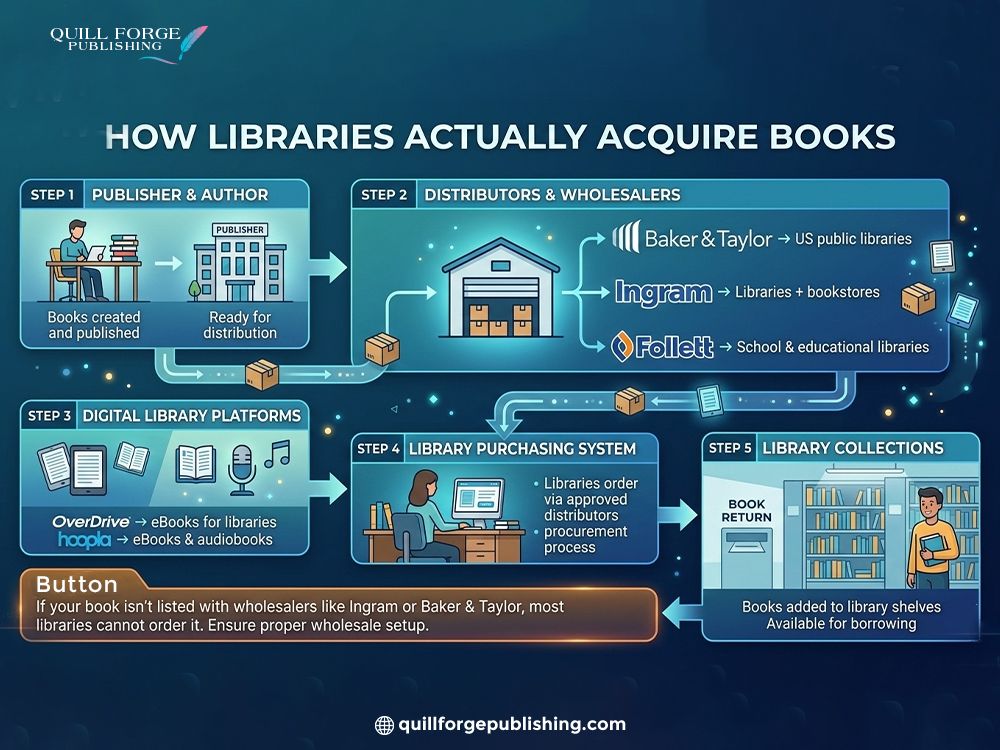
Understanding library purchasing systems is essential before approaching them with your title.
Libraries order through established channels:
Baker & Taylor supplies the majority of US public libraries with comprehensive catalog access.
Ingram serves libraries alongside bookstores through their wholesaler infrastructure.
Follett specializes in school libraries and educational institutions.
OverDrive and hoopla handle digital library lending for ebooks and audiobooks.
If your book isn’t available through these wholesalers, individual libraries can’t easily order it through their standard procurement processes.
Book distribution to libraries USA requires setting up proper wholesale relationships, not just making your book available on Amazon.
Why Proper Distribution Infrastructure Comes First
Before you can sell self-published book to libraries effectively, your distribution foundation must be solid.
Essential infrastructure includes:
ISBN registered to you as publisher, not a free platform ISBN that limits distribution options and credibility.
Wholesale pricing with appropriate library discounts (typically 40-55% off retail) that make your book economically viable for institutional budgets.
Returns policy accepting returns from wholesalers, which libraries expect as standard practice.
Quality metadata with proper Library of Congress categories and Dewey Decimal classification where applicable.
Professional production meeting durability standards libraries require for high-circulation materials.
Book distribution service providers handle these technical requirements so self-published authors access library markets without navigating complex wholesaler relationships independently.
How to Get Book Into US Libraries Through Strategic Targeting
Library placement works best when you target strategically rather than approaching randomly.
Effective targeting considers:
Local connections. Your hometown or current residence libraries are most likely to stock local authors.
Subject relevance. Libraries serving communities interested in your book’s topic prioritize relevant acquisitions.
Collection gaps. Librarians actively seek diverse voices and underrepresented perspectives in their collections.
Format preferences. Many libraries prefer hardcover for durability, though paperback and ebook options matter too.
Series potential. Libraries that stock book one in a series often automatically acquire subsequent volumes.
Start with libraries where you have genuine connection or relevance rather than mass-pitching every library system nationally.
Why Professional Production Standards Matter to Librarians
Libraries evaluate books differently than individual consumers. Durability and production quality directly affect whether they purchase.
Librarians assess:
Binding quality that survives multiple circulations and heavy handling.
Paper stock thick enough to prevent excessive wear and page damage.
Cover lamination protecting against spills, handling, and general abuse.
Print clarity ensuring text remains readable as books age.
Professional editing as errors reflect poorly on collection quality standards.
Books that look self-published in amateur ways get rejected regardless of content quality. Libraries maintain institutional reputations through their collections and can’t stock obviously unprofessional titles.
How Library Book Submission Services Streamline Institutional Sales
Navigating library submission processes, understanding cataloging requirements, and managing wholesaler relationships overwhelms most self-published authors.
Library book submission services handle:
Wholesaler setup ensuring your book appears in catalogs libraries actually use for ordering.
Metadata optimization with library-specific categorization and subject headings.
ARC distribution sending advance copies to library reviewers and selection committees.
Direct outreach to library systems where your book has clear relevance.
Review publication submission to Library Journal, Booklist, and other library-focused review sources.
These specialized services understand institutional buying cycles, budget constraints, and selection criteria that differ significantly from consumer book marketing.
Why Book Wholesalers for US Libraries Require Different Approaches
Wholesalers serving libraries have different requirements than consumer retail distributors.
Key differences include:
MARC records (Machine-Readable Cataloging) that libraries use for catalog integration.
Approval plans where libraries pre-authorize wholesalers to send books matching specific criteria.
Shelf-ready processing options where books arrive cataloged and ready to circulate.
Extended payment terms accommodating library budget cycles and fiscal year constraints.
Book distribution service providers experienced with library channels navigate these requirements so your book integrates seamlessly into institutional acquisition systems.
How Quill Forge’s Distribution Services Access Library Markets
Getting self-published books into libraries requires expertise most authors don’t have and don’t want to develop.
Quill Forge’s book distribution service includes comprehensive library access:
Their publishing infrastructure establishes wholesale relationships with Baker & Taylor, Ingram, and other library suppliers automatically.
Their metadata optimization includes library-specific cataloging information that facilitates institutional ordering.
Their production standards ensure books meet durability requirements libraries demand for high-circulation titles.
Their marketing & publicity team coordinates with library reviewers and selection committees that influence purchasing decisions.
For authors serious about library placement, Quill Forge removes technical barriers and positions books appropriately for institutional markets.
Why Reviews Matter More for Library Sales Than Consumer Sales
Individual readers browse and impulse purchase. Libraries rely heavily on professional reviews before acquisition.
Critical review sources for libraries include:
Library Journal reaching over 100,000 librarians with pre-publication reviews.
Booklist published by American Library Association with extensive library readership.
Kirkus Reviews providing professional critique that libraries reference for selection.
School Library Journal essential for children’s and young adult titles.
Publishers Weekly though primarily industry-focused, influences library buying.
Getting reviewed in these publications dramatically increases library ordering, but they’re difficult to access without proper industry positioning.
Quill Forge’s connections with review publications and understanding of their submission requirements help authors access these influential platforms.
How Digital Library Distribution Differs from Physical
Digital library lending through OverDrive, hoopla, and cloudLibrary operates under different models than physical book purchasing.
Digital library considerations include:
Licensing models where libraries pay per circulation rather than buying copies outright.
Simultaneous use limits controlling how many patrons can borrow digital copies concurrently.
Embargo periods some publishers impose before library digital availability.
Platform-specific formatting ensuring ebooks work within library lending systems.
Pricing structures vary significantly from consumer ebook pricing.
Comprehensive library distribution includes both physical and digital channels, maximizing institutional reach across all lending formats.
Start Your Library Distribution Journey
Libraries represent sustainable, long-term markets for quality books across all genres and categories.
Access requires proper distribution infrastructure, professional production, and strategic positioning that institutional buyers recognize and trust.
Your book deserves visibility in library collections where it can reach thousands of readers over years of circulation.
Ready to get your book into US libraries?
Book your free consultation with Quill Forge today and start your publishing journey with distribution services that provide comprehensive access to library markets nationwide.
Frequently Asked Questions
1. Do libraries actually buy self-published books?
Yes. Libraries actively seek diverse collections including quality indie titles. Proper distribution and professional production are essential for consideration.
2. How much do libraries pay for books?
Libraries purchase through wholesalers at standard institutional discounts (40-55% off retail). You receive royalties based on wholesale price, not retail.
3. Do I need special ISBN or cataloging for library sales?
You need standard ISBN registered to you as publisher. MARC records help but aren’t mandatory. Professional metadata increases ordering likelihood.
4. How long does library placement take?
Timeline varies. Local library connections can happen within weeks. Broader institutional adoption typically takes 3-6 months as libraries review and order through normal cycles.
5. Should I contact libraries directly or use distributors?
Both. Distribution through wholesalers enables standard ordering. Direct outreach to local libraries with personal connection supplements wholesale availability.
6. Do libraries prefer hardcover or paperback?
Most prefer hardcover for durability, but many purchase paperback for budget reasons. Offering both formats maximizes opportunities.
7. Can ebooks be sold to libraries?
Yes, through digital lending platforms like OverDrive. The licensing model differs from physical sales but represents significant market opportunity.
8. What genres do libraries purchase most?
Libraries purchase across all genres but particularly value nonfiction, local interest, diverse voices, and quality children’s books.
9. How does Quill Forge handle library distribution?
Quill Forge’s publishing services include automatic wholesale setup through library suppliers, metadata optimization, and strategic positioning for institutional markets.
10. Will library sales hurt retail sales?
No. Library circulation typically increases retail sales as readers discover your work through free borrowing then purchase other titles or recommend to friends.