
Your book is professionally written, edited, and designed. You hit publish on Amazon and wait for sales to roll in.
Nothing happens.
The problem isn’t your book quality. It’s that Amazon’s algorithm has no idea who should see your book or when to recommend it.
Metadata is the invisible infrastructure that determines whether Amazon shows your book to the right readers at the right time. Title, subtitle, description, categories, and keywords tell Amazon’s algorithm what your book is about and who might want to buy it.
Most self-published authors treat metadata as an afterthought, filling in fields quickly just to get their book live. Then they wonder why discoverability is terrible and sales never materialize.
Professional book metadata optimization services understand how Amazon’s systems actually work and position your book for maximum visibility.
Why Amazon Metadata Matters More Than Most Authors Realize
Amazon doesn’t promote books randomly. Their algorithm recommends titles based on complex calculations involving metadata, sales velocity, and customer behavior.
Strong metadata helps Amazon:
· Show your book in relevant searches when readers look for books like yours
· Recommend your book alongside successful titles in your category
· Surface your book in “customers also bought” suggestions
· Rank your book in specific subcategories where you can realistically compete
Poor metadata means Amazon doesn’t know where your book fits, who might want it, or when to recommend it.
You’re essentially invisible regardless of your book’s actual quality.
How Amazon KDP Keyword Research Services in USA Work
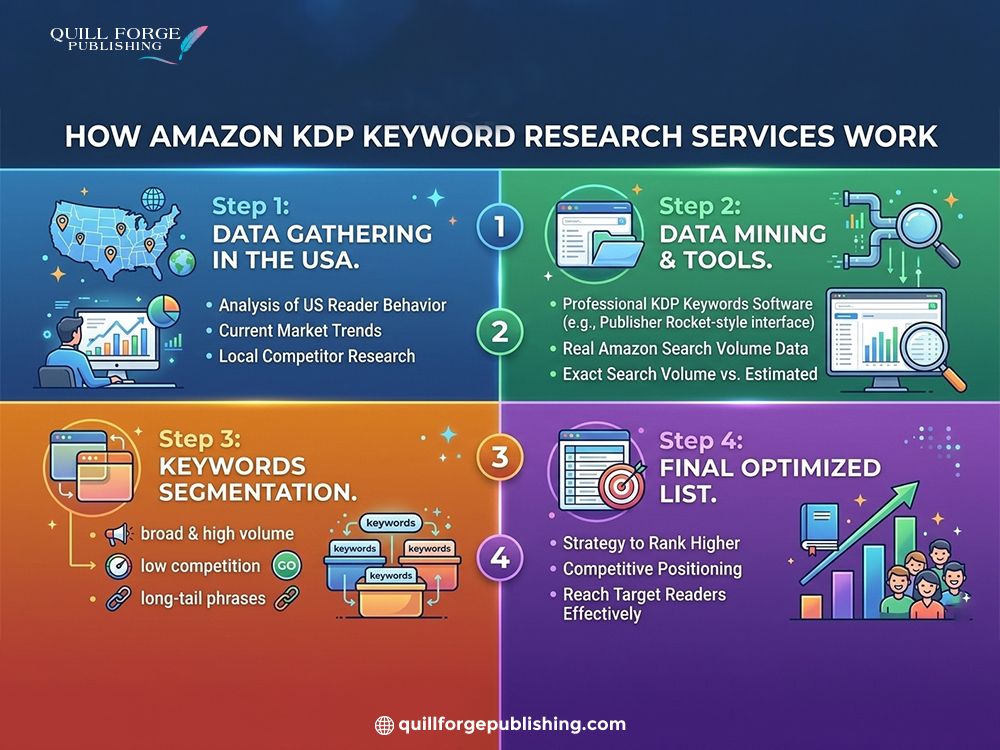
Amazon gives you seven backend keyword fields most readers never see. These keywords influence search visibility and algorithmic recommendations.
Amazon KDP keyword research services in USA identify:
· High-volume search terms readers actually use when browsing
· Low-competition keywords where your book can realistically rank
· Long-tail phrases capturing specific reader intent
· Variant spellings and alternative phrasings readers might use
· Related topics expanding your book’s discoverability
Professional keyword research uses data tools showing actual search volume and competition levels rather than guessing what might work.
The difference between random keywords and strategically researched terms directly impacts how many potential readers ever see your book.
Why Professional Book Category Research for US Amazon Changes Everything
Amazon allows you to select two categories during upload. But there are actually thousands of subcategories where your book might compete successfully.
Professional book category research for US Amazon finds:
· Niche subcategories with less competition but engaged readers
· Multiple category opportunities beyond your two direct selections
· Category combinations that position you strategically
· Bestseller list accessibility in categories you can actually rank in
Many authors choose broad categories like “Fiction > Thriller” where they’re competing against thousands of established titles.
Strategic category selection puts you in subcategories like “Kindle Store > Kindle eBooks > Mystery, Thriller & Suspense > Suspense > Political” where breaking into top rankings is achievable.
Small category rankings drive visibility, which drives sales, which improves broader rankings over time.
How to Increase Book Sales with Amazon Metadata Optimization
Metadata optimization isn’t just about filling in fields correctly. It’s strategic positioning that compounds over time.
Increase book sales with Amazon metadata optimization by:
· Front-loading keywords in your title and subtitle that readers actually search
· Writing descriptions that convert browsers into buyers with clear hooks
· Selecting categories where you can rank competitively and gain visibility
· Using backend keywords that expand your search presence without cluttering visible text
· Testing and adjusting based on performance data over time
Metadata works with your marketing efforts. Great metadata ensures that when you drive traffic to Amazon through ads or promotions, the algorithm recognizes your book’s relevance and amplifies that visibility.
Why Amazon Book SEO Services for Indie Authors Require Specialized Knowledge
Amazon’s search and recommendation algorithms aren’t publicly documented. They change frequently without announcement.
Amazon book SEO services for indie authors stay current on:
· Algorithm updates affecting search ranking and recommendations
· Category structure changes as Amazon adds or reorganizes subcategories
· Keyword performance shifts as reader search behavior evolves
· Competitive landscape in your specific genres and niches
What worked for metadata optimization in 2024 doesn’t necessarily work the same way in 2026.
Professional services track these changes and adjust strategies accordingly rather than applying outdated tactics.
How Best Amazon Backend Keywords for Book Sales Get Discovered
The seven backend keyword fields accept up to 50 characters each. That’s 350 characters to influence Amazon’s understanding of your book.
Best Amazon backend keywords for book sales come from:
· Publisher Rocket and similar tools showing actual search volume data
· Competitor analysis examining what works for successful similar titles
· Reader language research understanding exact phrases your audience uses
· Seasonal and trending topics relevant to your book’s themes
· Genre-specific terminology that signals your book’s category clearly
Backend keywords should never repeat words already in your title, subtitle, or description. That’s wasted space.
Use backend keywords to capture variations, synonyms, and related concepts that don’t fit naturally in visible metadata.
Why You Should Hire an Expert for Amazon Book Metadata
Most authors spend months writing their book and hours on metadata. That’s backwards given metadata’s impact on discoverability.
Hire an expert for Amazon book metadata when you want:
· Data-driven decisions rather than guesswork about categories and keywords
· Competitive positioning that accounts for current market dynamics
· Strategic descriptions that convert browsers while satisfying algorithms
· Ongoing optimization as performance data reveals what’s working
· Time savings by delegating technical research to specialists
Metadata expertise isn’t something most authors develop because they’re focused on writing, not marketing analytics.
How Quill Forge’s Book Metadata Audit Services USA Optimize Your Listings
Many authors publish with mediocre metadata and never revisit it. Meanwhile, their book languishes in obscurity.
Quill Forge’s book metadata audit services USA include:
· Complete analysis of current metadata identifying missed opportunities
· Keyword research using professional tools and competitive intelligence
· Category optimization finding the best positioning for your specific book
· Description rewriting that maintains your voice while improving conversion
· A/B testing recommendations for ongoing performance improvement
Their team understands that metadata isn’t set-it-and-forget-it. It’s an ongoing optimization process that responds to market changes and performance data.
For authors serious about Amazon sales, Quill Forge removes the guesswork and applies proven strategies.
Why Metadata Works with Marketing & Publicity
Strong metadata doesn’t replace marketing. It amplifies marketing efforts by ensuring Amazon’s algorithm recognizes and rewards your promotional activity.
When you run advertising, generate reviews, or drive external traffic to your Amazon page, proper metadata helps Amazon:
· Understand what readers who bought your book might want next
· Recommend your book to similar audiences automatically
· Rank you higher in relevant searches due to sales velocity
· Surface your book in algorithmic suggestions across the platform
Quill Forge’s marketing & publicity services coordinate with metadata optimization, ensuring promotional efforts and algorithmic visibility work together rather than in isolation.
How Metadata Affects Long-Term Discoverability
A book with strong metadata continues generating organic sales long after active promotion ends.
Amazon’s recommendation engine works 24/7. Proper metadata ensures your book appears in:
· “Customers who bought this also bought” suggestions
· Category browse pages where readers discover new titles
· Search results for relevant queries
· Personalized recommendations based on reader behavior
This passive discoverability creates sustained sales over months and years rather than just a launch spike followed by silence.
Start Optimizing Your Amazon Presence
Your book deserves to be discovered by readers who would love it. Amazon’s algorithm can make that happen, but only if your metadata gives it the right signals.
Most authors never realize how much sales potential they’re losing to poor metadata. They assume lack of sales means their book isn’t good enough when the real problem is discoverability.
Professional metadata optimization is one of the highest-ROI investments in self-publishing. It works continuously without ongoing costs, unlike advertising that stops when you stop paying.
Ready to optimize your book’s Amazon metadata for better discoverability?
Book your free consultation with Quill Forge today and start your publishing journey with metadata services that position your book for algorithmic success and sustained sales.
Frequently Asked Questions
1. Can I change my book’s metadata after publishing?
Yes. You can update title, subtitle, description, categories, and backend keywords anytime through your KDP dashboard. Changes typically go live within 72 hours.
2. How much does professional metadata optimization cost?
Pricing varies by service provider. One-time optimization is more affordable than ongoing management. Consider it an investment in long-term discoverability.
3. Will better metadata guarantee more sales?
No single factor guarantees sales, but proper metadata dramatically improves your chances by ensuring the right readers can actually find your book.
4. How often should I update my book’s metadata?
Monitor performance quarterly and update when you notice declining visibility, when Amazon changes category structures, or when launching new marketing campaigns.
5. What’s the most important metadata element?
All elements work together, but title/subtitle and categories have the biggest immediate impact on discoverability. Backend keywords provide additional reach.
6. Can I select more than two categories on Amazon?
You can select two directly. Additional categories require contacting KDP support with specific requests. Strategic selection matters more than quantity.
7. Should my keywords be single words or phrases?
Use phrases that capture actual reader searches. “psychological thriller” is more effective than just “psychological” and “thriller” separately.
8. How do I know if my current metadata is working?
Monitor your category rankings, search term reports (if running ads), and organic sales patterns. Declining visibility suggests metadata needs optimization.
9. Does Quill Forge provide ongoing metadata management?
Yes. Quill Forge offers both one-time optimization and ongoing management packages that adjust metadata based on performance data and market changes.
10. What makes Quill Forge’s metadata services different?
Quill Forge combines data-driven research with comprehensive publishing knowledge, ensuring metadata optimization integrates with overall marketing strategy rather than existing in isolation.