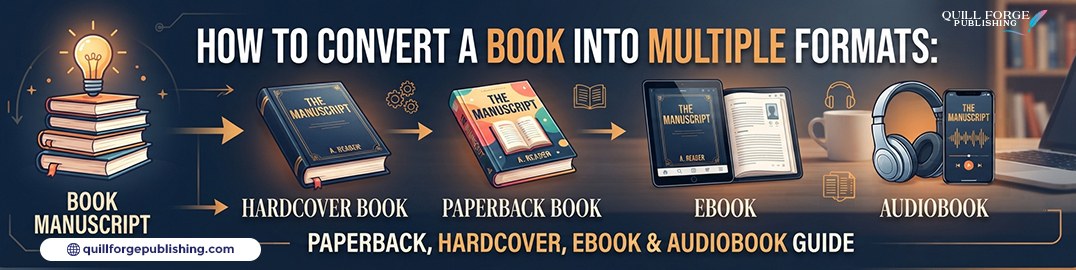
Publishing in multiple formats maximises your book's reach and revenue by putting it in front of readers who only buy in one specific format.
-
Ebook — lowest cost to produce ($300–$600), highest per-unit margin, widest digital distribution
-
Paperback — print-on-demand via KDP (Amazon) + IngramSpark (wide), no inventory needed
-
Hardcover — higher list price, stronger gift/library market, POD available via KDP and IngramSpark
-
Audiobook — fastest-growing format, $1,500–$5,000+ production cost, distributed via ACX + Findaway Voices
Recommended starting order: Ebook + Paperback at launch → Hardcover after validating demand → Audiobook when budget allows.
Most authors publish one format and leave money — and readers on the table. The reader who buys only physical books will never find your ebook-only title. The commuter who listens to audiobooks on their morning drive will never read your paperback. The library system that acquires hardcovers for their collection won't order your POD paperback.
Learning how to publish a book in multiple formats is one of the highest-impact decisions a self-published author can make. This guide covers how each format works, what our book formatting services and production involve, realistic conversion costs, how to convert a book to ebook and audiobook, and which platform distributes each format most effectively.
Key Takeaways
-
Each format serves a different reader and retail channel — publishing in all four maximises total readership and revenue.
-
Ebook and paperback should launch simultaneously — same manuscript, lowest combined production cost.
-
Hardcover is worth adding once your book has proven demand — it opens the gift market and library acquisition channels.
-
Audiobook is the fastest-growing format globally (25%+ annual market growth) but carries the highest production cost.
-
KDP handles Amazon across all formats; distribution partners like IngramSpark, Draft2Digital, ACX, and Findaway Voices handle the rest.
-
Print and ebook formatting are different disciplines — both require platform-specific technical standards that DIY formatting frequently misses.
The Four Book Formats at a Glance
Each format serves a distinct purchasing behaviour these are additive audiences, not competing ones. Every format you add reaches readers who wouldn't have found you otherwise. See how a full self-publishing budget breaks down across all four.
How Do You Convert a Book to an Ebook?
An ebook isn't simply a PDF of your print book. Ebook formatting creates a reflowable file the text adapts to the screen size and font settings of whatever device the reader uses. A poorly formatted ebook breaks on e-readers and generates negative reviews about formatting rather than content.
What the process involves:
-
Source file prep — a clean, consistently styled Word document with no manual spacing or tabs.
-
EPUB conversion — the universal ebook standard, produced with tools like Vellum, Atticus, or Sigil. KDP also accepts DOCX, but EPUB gives better control.
-
Ebook-specific formatting — chapter headings, drop caps, scene breaks, image placement, and TOC structure all need medium-specific treatment.
-
Metadata configuration — title, author, ISBN, description, and categories embedded correctly on every platform.
For a closer look at pricing and platform requirements, see our guide to affordable ebook conversion for Kindle and Apple Books.
A professional formatter delivers a tested EPUB that displays correctly across Kindle, Apple Books, Kobo, and other major e-readers testing on multiple devices before publishing is non-negotiable.
How Is Print Formatting Different From Ebook Formatting?
Print formatting is a fundamentally different discipline. Where ebook formatting creates a reflowable file, print formatting creates a fixed layout margins, font size, line spacing, gutter, headers, footers, and chapter openings are all precisely specified and don't change between copies.
What print formatting covers:
-
Trim size — 5.5×8.5″ or 6×9″ for fiction; 6×9″ or 7×10″ for nonfiction. This affects spine width and your cover design file specs.
-
Margins and gutter — inner margins that account for binding; more pages need wider gutters.
-
Typography — line spacing, font choice, and indentation calibrated for extended print reading.
-
Headers, footers, and front matter — chapter titles, page numbers, title page, copyright page, TOC, dedication.
-
Interior images — 300 DPI, CMYK, correctly placed relative to text.
-
File output — a press-ready 300 DPI CMYK PDF with 0.125″ bleed, submitted to KDP and IngramSpark's exact specs.
For the exact technical requirements, see how to format your book for Amazon KDP.
What Does It Cost to Convert a Book to Ebook, Print, and Audiobook?
Realistic 2026 conversion cost ranges:
Most authors produce ebooks and paperbacks together since the source manuscript is the same — the combined cost is typically $500–$900, making simultaneous publication the most cost-efficient approach.
How Do You Convert a Book to an Audiobook?
Audiobook production is the most complex format conversion script prep, narrator casting, recording, editing, mastering, and quality control across a multi-week timeline.
Narrator selection is the single most important decision — always listen to genre-specific samples and request an audition from your own manuscript. For a full cost breakdown, see how much it costs to produce an audiobook, or explore our audiobook production services.
What Is the Best Order to Publish in Multiple Formats?
-
Stage 1 — Launch: Ebook + Paperback. Same manuscript, lowest combined cost, covers the majority of the commercial market. Start with a solid book publishing plan.
-
Stage 2 — After validating demand: Hardcover. Opens the gift market, library acquisition, and a higher list price.
-
Stage 3 — When budget allows: Audiobook. Highest cost, fastest-growing format — prioritise it for narrative nonfiction, memoir, business books, and story-driven fiction.
Have Questions About Book Formatting or Multi-Format Publishing?
Quill Forge Publishing coordinates ebook, print, and audiobook formatting and production — all formats, all major platforms, with full technical quality control before distribution.
-
Ebook formatting (EPUB + KDP-ready files)
-
Print formatting for paperback and hardcover
-
Audiobook production coordination via ACX and Findaway Voices
-
Global distribution setup across 60,000+ bookstores, libraries, and retail platforms
📞 +1 (512) 380-1661 📧 info@quillforgepublishing.com
🌐 www.quillforgepublishing.com
→ Book a Free Formatting Consultation
FAQs:
1. Should I publish my book in all four formats at once?
No most authors start with ebooks and paperbacks, then add hardcovers once sales validate demand, and audiobooks when budget allows.
2. How much does it cost to convert a book to all four formats?
Typically $2,000–$7,000 total, depending on length and complexity. Ebook + paperback together run $500–$900.
3. What's the difference between ebook and print formatting?
Ebook formatting creates a reflowable EPUB; print formatting creates a fixed-layout PDF for a specific trim size. Same manuscript, entirely different files.
4. How do I convert my book to an ebook?
Start with a clean Word file, have a formatter produce a tested EPUB, configure metadata, then upload to KDP and Draft2Digital. It takes about 1–2 weeks.
5. What does Amazon KDP formatting require for print books?
A press-ready 300 DPI CMYK interior PDF at your chosen trim size, plus a separate cover PDF with correct spine width and 0.125″ bleed.
6. How do I produce an audiobook for my self-published book?
Prepare a clean script, cast a narrator via ACX or Findaway Voices, review recorded chapters, then distribute. The process takes 4–12 weeks.
7. What's the difference between ACX and Findaway Voices?
ACX reaches Audible/Amazon at up to 40% royalty (exclusive); Findaway Voices reaches 40+ platforms at 80%+ royalty. Most authors use both strategically.
8. Is hardcover publishing worth it for self-published authors?
Usually yes, once demand is proven hardcovers command a higher list price, appeal to libraries, and dominate the gift market.
9. What is a professional ebook conversion company and do I need one?
It's a specialist that produces a technically compliant EPUB passing KDP, Apple Books, and Kobo validation. Simple novels can be DIY; complex nonfiction usually needs professional handling.
10. Does Quill Forge Publishing offer multi-format book formatting?
Yes ebook, print, and audiobook formatting plus global distribution setup. Contact us or call +1 (512) 380-1661 for a free consultation.