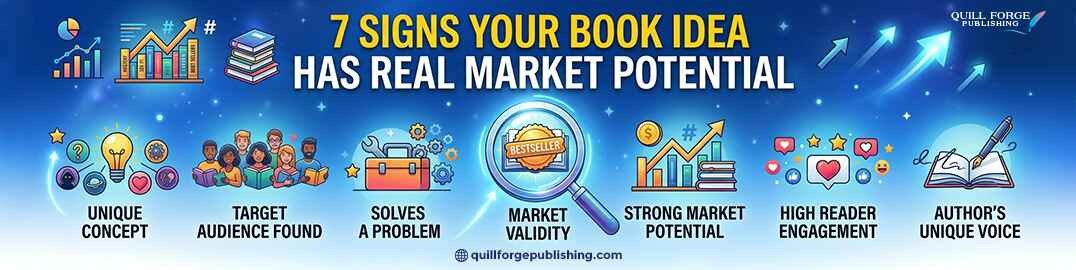
A book idea has real market potential when it meets three conditions: readers are already searching for it, books in the same category are actively selling on Amazon, and you can describe your exact target reader in one specific sentence.
The 7 signs covered in this guide:
-
Proven search demand for the topic
-
An active, selling Amazon category
-
A clearly identifiable target reader
-
Competitors exist but no single title dominates
-
Readers in the category are spending real money
-
The idea translates to a clear, compelling title
-
You bring a unique angle or authority to the topic
Most authors fall in love with their book idea before they've tested whether readers will fall in love with it too. The result is a well-written, professionally published book that never finds its audience not because the writing was poor, but because the market research wasn't done before the manuscript was written. This is one of the most common threads we see across 10 biggest first-time author mistakes: writing first and validating never.
Understanding how to validate a book idea before you invest months of writing time — or thousands of dollars in editing, design, and publishing — is one of the most commercially valuable skills any author can develop. This guide covers the seven concrete signals that tell you whether your book idea is worth publishing, how to conduct basic book market research without specialist tools, how to find your target audience, and which profitable book niches are showing the strongest signals in 2026.
Key Takeaways
-
Market validation is done before you write the full manuscript — not after.
-
The best market signal is an active Amazon category with books that have 50–500 reviews: proven demand, not yet dominated.
-
Book market research doesn't require paid tools — Amazon's search bar, Google Trends, and Goodreads are free and reliable.
-
A clearly defined target reader is the single most important thing you can establish before writing a word.
-
Passion for your topic is necessary but not sufficient. Market potential requires both passion and demand.
-
The riskiest niches are the most obvious ones — broad self-help, generic productivity, and oversaturated weight-loss categories are dominated by established titles and very difficult for debut authors to penetrate.
Why Does Book Market Research Matter Before You Start Writing?
The book publishing market is not a meritocracy. The best-written book does not automatically find its readers. Discovery on Amazon depends on category placement, search keywords, cover signals, review volume, and a dozen other factors that are downstream of the market decisions you make before you write the first chapter.
Authors who validate their idea first — who confirm that readers exist, are searching, and are spending money in their category before committing to a full manuscript — consistently outperform authors who write first and market later. The validation process also improves the book itself: knowing exactly who your reader is, what they've already read, and what gap your book fills makes every writing decision clearer and every chapter more focused. This is the same reasoning behind our complete author roadmap for nonfiction books, which treats market positioning as step one, not an afterthought.
None of this requires complex tools or expensive book idea consultation. The signals are available to anyone with an Amazon account, a Google search bar, and an hour of structured research time.
What Are the 7 Signs Your Book Idea Is Worth Publishing?
Sign 1: How Do You Check Proven Search Demand When Validating a Book Idea?
Search demand is the most objective market signal available to authors. If people are actively typing your topic into Google and Amazon, they are telling you they want information on that subject — and are potentially willing to pay for a book that delivers it well.
How to check search demand:
-
Amazon search bar autocomplete. Type your book's core topic into Amazon's search bar and let it autocomplete. Every suggestion is a phrase that real users have searched for. If your topic generates multiple specific autocomplete suggestions, there is active search demand.
-
Google Trends. Search your topic on Google Trends (trends.google.com) and check whether search interest is stable, growing, or declining. A growing trend is the best signal. A stable trend indicates evergreen demand. A declining trend is a risk flag.
-
Goodreads shelves. Search your topic on Goodreads and look at how many readers have shelved books in that category. Large shelf counts indicate an active and book-buying reader community.
No search demand doesn't always mean no market — but it means you'll need to create awareness rather than capture existing demand, which is a significantly harder and more expensive marketing challenge. Search demand also has a shelf life: if you spot a fast-moving trend, timing your launch matters, which is exactly why authors ask when they should start marketing their book well before the manuscript is even finished.
Sign 2: How Do You Use Amazon to Research Your Book Publishing Market Trends?
Amazon is the world's largest book market and the most reliable source of real-time book publishing market trends available to independent authors. Here is how to use it for validation:
-
Check category bestseller lists. Go to Amazon Books → Browse Categories → find your most specific applicable category. Look at the top 20 titles. Are they recently published (within the last 3 years)? Do they have substantial review counts (50–500+)? Active review accumulation signals an actively buying readership.
-
Look at the "Best Seller Rank" (BSR). Every Amazon book has a BSR. A BSR below 100,000 in the main Books category means the book sells at least a few copies per day. Multiple books with BSR below 50,000 in your category confirm an actively purchasing audience.
-
Check the "Customers Also Bought" section. The books listed alongside bestsellers in your category show you the competitive landscape. These are the titles your book will be placed next to. Read their reviews the one- and two-star reviews tell you what readers wanted but didn't get. That's your gap.
-
Look at publication dates. If the bestsellers in your category are all 10+ years old with no recent titles breaking through, that may signal a stagnant category that's no longer actively growing. The healthiest categories have a mix of established titles and recent entrants performing well.
Review volume is one of the strongest signals in this list, and it's worth understanding both sides of it. Once your own book is live, the same review mechanics that helped you validate the category become the thing readers use to validate you — our practical guide to getting book reviews on Amazon walks through how to build that social proof ethically. And once you know your category is active, the platform you publish through matters just as much as the idea itself — see our comparison of Amazon KDP vs. IngramSpark vs. Draft2Digital for how distribution choice affects reach in your category.
Sign 3: How Do You Find Your Target Audience for a Book Before You Write It?
The most reliable sign of a viable book idea is a clearly defined, reachable target reader. Not "anyone interested in self-improvement" or "mothers." A specific person: "first-generation immigrant women in their 30s navigating corporate careers in the US." The narrower and more specific your reader definition, the more powerfully your book can speak to them and the easier every marketing decision becomes.
How to find and define your target reader:
-
Describe your reader in one sentence. If you cannot write a single specific sentence describing exactly who reads your book, your market isn't defined yet. Keep narrowing until you can.
-
Find where they already gather. Reddit communities, Facebook groups, Goodreads groups, podcasts, newsletters, YouTube channels. If an active community exists around your book's topic, your reader exists and is findable.
-
Read the reviews they leave. One- and two-star reviews on competing books tell you what readers wanted and didn't get. Five-star reviews tell you what they loved. Both are direct feedback from your target reader on what your book should deliver.
-
Check who follows the authors of similar books. Look at the social media followers and Goodreads followers of authors in your category. The demographics and interests of those followers are a direct window into your target reader profile.
Defining a target reader is often the exact point where authors with real expertise get stuck they know the subject cold but struggle to translate it into a book aimed at a specific person. That's the gap our book coaching for nonfiction authors service exists to close, turning subject-matter knowledge into a manuscript built around one reader's needs.
What Are the Most Profitable Book Niches in 2026?
Understanding profitable book niches helps you evaluate whether your idea is entering a healthy market or fighting for attention in an oversaturated one. Here is how the major niche types break down for book publishing market trends in 2026:
The strongest position for a debut author is an underserved niche with an active reader community: high passion, lower competition, and readers who have been waiting for exactly this book. The weakest position is a generic niche dominated by established titles from authors with major platforms and publishing houses behind them. If you're weighing a business or expertise-driven nonfiction niche specifically, our nonfiction author roadmap breaks down how positioning changes by category.
Signs 4–7: What Else Tells You How to Validate a Book Idea Before Committing?
Sign 4: Competitors exist but don't dominate. A category with zero competing books has no proven demand. A category dominated by a single bestseller that's been #1 for five years is very difficult to break into. The sweet spot: a category where multiple titles are performing well, none is so dominant that it captures all reader attention, and recent entrants are finding readers. This tells you the market is active and still growing.
Sign 5: Readers are spending real money. Price anchoring in a book category is a meaningful market signal. If books in your category are consistently priced at $14.99–$27.99 and selling, readers have established that they value the content enough to pay professional prices. A category where books are priced at $0.99 or permanently free signals a different kind of market often one where volume matters more than per-book revenue.
Sign 6: The idea translates to a clear, compelling title. A book with a strong market position can almost always be summarised in a single compelling sentence: what it's about, who it's for, and what the reader gets. If you cannot write that sentence, your idea may not be focused enough yet. A working title that communicates the book's premise clearly is itself a validation signal — and once you have that sentence, your cover needs to sell it in under two seconds on a search results page. Our book cover design checklist covers exactly what a category-appropriate cover needs to signal to a browsing reader.
Sign 7: You bring unique authority or a genuinely different angle. Read the five bestselling books in your exact category. If your book would say essentially the same things in a similar way, you're not adding to the conversation — you're competing with established titles for the same reader at a disadvantage. Your book needs to bring something those books don't have: a different methodology, a specific sub-audience, a unique personal experience, a fresh research angle, or a voice and perspective that's genuinely distinct. If you have the expertise and the angle but not the time or writing bandwidth to get it onto the page, it's worth asking whether hiring a ghostwriter is worth it for business authors — a validated idea is still an asset even when someone else helps you write it.
When Should You Seek a Book Idea Consultation or Professional Author Coaching Services?
Self-guided validation using the signals in this guide is the right starting point for most authors. But there are situations where professional author coaching services and book idea consultation provide value that self-research cannot:
-
You've done the Amazon and Google research and the signals are mixed — some indicators are strong, others are weak — and you can't interpret what the data is telling you
-
You have multiple book ideas and aren't sure which one has the strongest market position
-
You're writing in a niche where you have genuine expertise but aren't sure how to position it for a commercial audience
-
You've started writing and the manuscript isn't coming together, and you suspect the premise may need rethinking
-
You want a professional second opinion on your market research before committing to a full manuscript and publishing investment
If you've already got a full manuscript and are past the idea-validation stage, the next decision point is usually structural rather than commercial — our checklist for what to do after finishing your first draft picks up exactly where this guide leaves off. And if editing quality is what's holding you back from testing the market with a finished product, how to find a book editor is the natural next read.
Have a Book Idea You'd Like to Pressure-Test? Here's How We Can Help
If you've done your initial research and you're still not sure whether your idea has real commercial potential, a free 30-minute consultation with the Quill Forge Publishing team gives you a structured, honest assessment of your market position what the signals say, where the gaps are, and what a realistic publishing path looks like for your specific idea.
We're not here to tell you your idea is great, we're here to help you figure out whether it is, and what to do with that information. No obligation, no pressure.
-
Book idea market assessment — structured evaluation of your category, competition, and target reader
-
Author coaching services — ongoing support from concept through manuscript completion
-
Full publishing services — editing, cover design, formatting, global distribution, and marketing when you're ready to publish
+1 (512) 380-1661 info@quillforgepublishing.com www.quillforgepublishing.com
Frequently Asked Questions:
1. How do I know if my book idea is worth publishing?
A book idea is worth publishing when it meets three conditions: readers are actively searching for the topic (confirmed through Amazon autocomplete and Google Trends), books in the same category are actively selling with real review volume (confirmed through Amazon bestseller lists and BSR), and you can define your target reader in a single specific sentence. Is my book idea worth publishing is a research question, not a feeling and those three signals give you an objective answer. It's also worth understanding the difference between a real publisher and a vanity press before you commit, since a strong idea deserves a legitimate publishing path.
2. What is the best free tool for book market research?
Amazon is the most powerful free tool available for book market research. The search bar autocomplete shows you what real buyers are searching for. The bestseller lists show you what's currently selling. The BSR tells you how many copies of specific books are moving. The customer reviews tell you what readers loved and what they didn't get. Google Trends and Goodreads complete the picture. You don't need paid keyword tools to do meaningful book market research — you need to spend structured time in Amazon's book ecosystem.
3. What makes a book idea commercially viable vs just interesting?
A commercially viable book idea has a specific reader who is actively looking for it, a category where readers are already spending money, and a positioning that's distinct enough to give new readers a reason to choose it over established titles. An interesting book idea may have all of those qualities or it may be primarily interesting to the author and a small circle of people who share the author's specific context. The validation process in this guide is specifically designed to distinguish between the two, and it's the same distinction we cover in 10 biggest first-time author mistakes.
4. How do I find the target audience for my book?
Start with a one-sentence reader description that is as specific as possible. Then verify that the reader exists by finding the communities where they gather Reddit, Facebook groups, Goodreads shelves, podcasts, YouTube channels. Read the reviews they leave on competing books to understand exactly what they want. Find your target audience by working backward from the books they're already reading and the reviews they're already leaving, rather than forward from your own assumptions about who should read your book.
5. What are the most profitable book niches in 2026?
The strongest profitable book niches in 2026 combine consistent reader demand with reasonable competition levels. High-performing categories include: health and wellness with a specific demographic focus (menopause, ADHD, chronic illness), personal finance for specific life stages (new graduates, divorce, early retirement), business books with a methodology or niche industry focus, narrative nonfiction in true crime and memoir, illustrated children's books with a clear age-and-theme focus, and genre fiction categories in romance (particularly dark romance and romantasy), thriller, and cozy mystery. If children's publishing is on your list, budgeting matters early — see how much children's book illustration costs in 2026. The risk categories to avoid as a debut author: generic self-help, broad productivity, and oversaturated weight-loss titles dominated by established platforms.
6. How long should I spend on book market research before writing?
A thorough book market research process takes 4–8 hours of structured research time — not months. Spend one hour on Amazon (bestseller lists, BSR, review analysis), one hour on Google Trends and search demand, one hour finding and reviewing reader communities, and one to two hours reading the top competing titles in your category. The remaining time should be spent synthesising what you've found into a clear reader definition and positioning statement. If after 8 hours of research you can't clearly define your reader and your competitive angle, the idea needs more development before you commit to the manuscript.
7. What if my book idea is too niche to have a large market?
Small, passionate, and underserved markets are often better than large, crowded ones for debut authors. A book that speaks directly and specifically to 50,000 deeply engaged readers will consistently outperform a book that broadly addresses 5 million readers who are already well-served by established titles. The question is not "how many people could potentially read this" but "how many people are actively looking for exactly this and not finding it." That second number is your real market.
8. What is the difference between validating a fiction idea vs a nonfiction idea?
Nonfiction validation is primarily topic and keyword-driven: is the subject being searched for, and are books on this subject selling? Fiction validation is primarily genre and subgenre-driven: is there an active reader community for this genre combination, and are similar books performing well? For fiction, book market research focuses on subgenre conventions, cover design signals, comparable title performance, and reader community activity on platforms like Goodreads and BookTok. For nonfiction, it focuses on search demand, category bestseller performance, and your positioning relative to existing titles a process our nonfiction author roadmap covers step by step.
9. Can I validate a book idea before I've written any of it?
Yes and this is exactly when validation is most valuable. Validating your idea before writing the manuscript means you can adjust your angle, refocus your target reader, or even choose a different but related topic if the research suggests a stronger opportunity. Validating after writing locks you into defending a premise that may not be commercially optimal. The best authors treat validation as the first stage of the writing process, not the last stage before publishing.
10. Does Quill Forge Publishing offer book idea consultation or author coaching services?
Yes. Quill Forge Publishing offers book idea consultation and author coaching services for authors at every stage — from initial idea validation through manuscript completion. A free 30-minute consultation gives you a structured market assessment of your book idea, including category analysis, target reader definition, competitive positioning, and an honest view of your publishing options. Call +1 (512) 380-1661 or visit quillforgepublishing.com/contact-us to book your free session.