You've finished your manuscript and you're searching for publishing options. Within days, you start receiving emails from companies telling you they'd love to publish your book. They have professional-looking websites, impressive-sounding packages, and glowing testimonials. They call themselves publishers.
Some of them are not publishers. They are vanity publishing companies — businesses whose revenue comes from charging authors fees, not from selling books. The distinction matters enormously, because signing with the wrong company can cost you thousands of dollars, lock you into a damaging contract, and do serious long-term harm to your book's commercial prospects.
This guide explains the real publisher vs vanity press difference in plain terms what each model is, how to tell them apart, what vanity press cost actually looks like, and what the legitimate book publishing companies and professional alternatives offer instead. By the end, you'll know exactly what to look for and what to run from.
Real Publisher vs Vanity Press: The Core Difference Every Author Must Understand
The fundamental difference between a real publisher and a vanity press comes down to one question: who is paying whom?
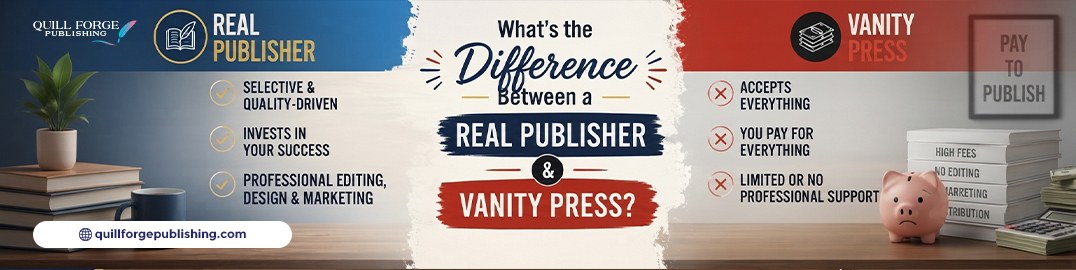
A real publisher whether traditional, independent, or hybrid invests in the books it publishes. It pays for editing, cover design, formatting, distribution, and marketing. In a traditional model, it also pays the author an advance against future royalties. The publisher's commercial interest is directly aligned with the book's success: if the book doesn't sell, the publisher loses money.
A vanity press inverts this entirely. The author pays the publisher for services. The publisher earns its revenue the moment the contract is signed, regardless of how the book performs. There is no commercial alignment between the vanity press and the author's success the press has already been paid.
This single distinction who pays whom, and therefore whose interests are aligned with the book's commercial outcome is the clearest way to evaluate any publishing company you're considering. A company that earns money whether your book sells or not has no financial incentive to help it sell.
Traditional Publisher vs Vanity Press: Full Comparison Across Every Factor That Matters
Here is how every major publishing model compares across the factors that affect your rights, your royalties, and your book's long-term commercial performance:
Vanity Press Cost: What Vanity Publishing Companies Actually Charge Authors
One of the clearest signals that you're dealing with a vanity press is the fee structure. Vanity press cost varies widely, but the pattern is consistent: high upfront fees for services that legitimate publishers include as standard, combined with low or opaque royalty structures that ensure the press profits regardless of sales.
Common Vanity Publishing Fee Structures in 2026
-
"Basic" packages: $3,000–$7,000. Typically includes minimal editing (or none), a template cover design, print-on-demand setup, and an Amazon listing. Distribution is usually Amazon-only or the press's own storefront. Royalties are often 10–20% of the press's net receipts which, after Amazon's cut and the press's own margin, can leave the author earning $0.50–$1.50 per sale on a $15 book.
-
"Premium" packages: $8,000–$15,000. Adds light editing, a slightly less generic cover, and sometimes a press release. Distribution remains limited. The royalty structure rarely improves meaningfully despite the higher fee.
-
"Elite" or "Prestige" packages: $15,000–$25,000+. The same core services as the premium package with additional marketing add-ons — social media posts, a website page, and sometimes a listing on the press's catalogue. The marketing delivered rarely justifies the additional cost.
For comparison: a professional full-service publishing company provides genuine editorial services, genre-matched cover design, global distribution across Amazon, IngramSpark, and 40+ retailers, and high net royalties at transparent, itemised pricing where the author keeps meaningful earnings on every sale.
If you want a full breakdown of what things should actually cost, our self-publishing costs guide for 2026 walks through real numbers by service.
How to Identify a Vanity Publisher: The Complete Red Flag Checklist
The vanity publishing companies operating in 2026 are more sophisticated than they used to be. Many have professional websites, publishing industry terminology, and testimonials from satisfied clients (often curated). Knowing how to identify a vanity publisher before you sign is the most important research you'll do in your publishing journey.
Book Publishing Companies That Don't Charge Authors: What Traditional Publishing Actually Looks Like
True book publishing companies that don't charge authors are traditional publishers the Big Five (Penguin Random House, HarperCollins, Simon & Schuster, Hachette, and Pan Macmillan) and their imprints, along with thousands of smaller independent publishers that operate on the same model: the publisher invests in the book, the author receives a royalty.
In Traditional Publishing, the Publisher:
-
Pays the author an advance against future royalties (typically $1,000–$500,000+ depending on the publisher, genre, and author profile)
-
Covers all production costs — editing, cover design, formatting, printing
-
Handles distribution through established trade channels
-
Provides a marketing budget (variable by publisher and title)
-
Takes on commercial risk — if the book doesn't recoup the advance, the publisher absorbs the loss
In exchange, traditional publishers take the majority of royalties (typically 85–92% of net receipts), retain significant creative control, and hold publishing rights for the term of the contract — which is usually the life of the copyright.
Getting a traditional publishing deal in 2026 requires a literary agent for most major publishers, and agent representation typically requires a track record, a strong platform, or an exceptional manuscript in a commercially viable genre. For debut authors without an existing audience, traditional publishing is a highly competitive path with long timelines — 12–24 months from acquisition to publication is standard. If that timeline doesn't suit you, our 7-step guide to publishing a book covers the faster independent route.
Best Publishing Companies for First Time Authors: Understanding Hybrid Publisher vs Vanity Press
Between traditional publishing and vanity presses lies the hybrid publishing model — and understanding the difference between a legitimate hybrid publisher and a vanity press disguised as one is essential for any first-time author evaluating their options.
A Legitimate Hybrid Publisher
-
Has a quality threshold — it does not accept every manuscript
-
Charges transparent, itemised fees for specific professional services
-
Provides genuinely professional editorial and design work from credentialed professionals
-
Offers the author high royalties (typically 50–70%+) and full copyright retention
-
Distributes through genuine trade channels — IngramSpark, Amazon KDP, wide ebook platforms
-
Has a verifiable backlist of professionally produced titles
A Vanity Press Disguised as a Hybrid Publisher
-
Accepts all manuscripts with no editorial review
-
Charges high fees for vaguely defined services
-
Delivers template-driven cover design and minimal or no real editing
-
Offers low royalties despite high upfront fees
-
Has limited or no genuine trade distribution
-
Cannot produce a backlist of titles with strong sales and professional production quality
The hybrid publisher vs vanity press distinction is not always obvious from marketing materials. The test is always the same: request a full itemised quote, ask to see their published backlist, find those books on Amazon, check their production quality and sales rank, and verify the royalty structure in writing before signing anything. We've also compared the two publishing paths in more depth in hybrid publishing vs self-publishing for US authors, if you want to weigh your options further.
Legitimate Book Publishing Companies: What Professional Book Publishing Services Actually Include
Whether you're working with a traditional publisher, a hybrid publisher, or a full-service self-publishing company, legitimate book publishing companies share a set of non-negotiable standards that vanity presses consistently fail to meet:
Professional editing. Developmental editing, copy editing, and proofreading performed by credentialed editors with verifiable publishing credits. Not a spell-check pass. Not a single "content review." A genuine editorial process that improves the manuscript. Our editing services cover all three levels.
Genre-matched cover design. A cover designed by a professional who understands your specific genre's visual conventions and has produced covers that have sold books. Not a Canva template with your title dropped in. See examples of our book cover design work.
Global distribution. Your book available for purchase on Amazon, through IngramSpark's 40,000+ retail and library network, and across wide ebook platforms. Not just on the publisher's own website or Amazon-only. Details on how this works are on our book distribution page.
Transparent royalty structure. A clear, written royalty percentage on every sales channel, with no hidden deductions or opaque "net receipts" calculations that erode your earnings before you see them.
The author retains copyright. Non-negotiable. Your book is yours. Any publishing agreement that asks for a share of your copyright in exchange for services — rather than acquisition — is not operating ethically.
Accountable timeline and deliverables. A professional publishing company works on a signed contract with defined deliverables, timelines, and revision policies. Vague promises with no contract is the hallmark of a vanity press.
Quill Forge Publishing: Professional Book Publishing Services With Full Author Rights and Transparent Pricing
At Quill Forge Publishing, we are a full-service publishing company — not a vanity press. The distinction matters to us as much as it does to you. We provide professional book publishing services including developmental editing, copy editing, proofreading, genre-matched cover design, interior formatting, global distribution, and book marketing — with full author copyright retention, high net royalties, and transparent itemised pricing on every engagement.
We are one of the best publishing companies for first time authors because we've built our service model around what first-time authors actually need: honest guidance, professional execution, and a publishing partner whose success depends on the same outcome as yours — a well-published, widely distributed, commercially competitive book. You can read more about our team and approach on our about us page.
What You Get With Quill Forge
-
Full author copyright retention on every title
-
Transparent, itemised pricing with no hidden fees
-
Professional editing at every level — developmental, line, copy, and proofread
-
Genre-matched cover design and interior formatting to platform specifications
-
Global distribution across Amazon KDP, IngramSpark's 40,000+ retail network, and 40+ ebook platforms
-
High net royalties clearly defined in writing before you sign
Get in touch: 📞 +1 (512) 380-1661 📧 info@quillforgepublishing.com
🌐 www.quillforgepublishing.com
→ Get Your Free Publishing Consultation
Frequently Asked Questions:
1. What is the simplest way to tell a real publisher from a vanity press?
Ask one question: who pays whom? A real publisher pays the author (through an advance and royalties) and covers all production costs. A vanity press charges the author fees upfront and earns its revenue regardless of whether the book sells. If you are being asked to pay to have your book published by someone calling themselves a publisher, you are dealing with a vanity press. That doesn't necessarily mean the services are worthless but it means you need to evaluate the services and costs independently, as you would any other paid service provider.
2. How much do vanity presses charge?
Vanity press cost typically ranges from $3,000 to $25,000 or more, depending on the package. Basic packages run $3,000–$7,000 and usually include minimal editing, a template cover, and Amazon-only distribution. Premium and "elite" packages charge $8,000–$25,000+ for additional services that rarely deliver proportional value. For comparison, sourcing professional editing, cover design, formatting, and global distribution independently from reputable providers typically costs $3,000–$8,000 — with full creative control, higher royalties, and accountability for every service.
3. Are vanity presses illegal?
No. Vanity publishing companies operate legally. The problem is not legality it's the mismatch between what is promised and what is delivered, and the exploitative fee structures that extract maximum payment from authors in exchange for minimal commercial support. Some vanity presses cross legal lines with misleading marketing or contract terms that violate consumer protection laws, but most operate in a legal grey area that is technically honest while being practically predatory.
4. Can a book published through a vanity press succeed commercially?
Occasionally, but rarely. The structural disadvantages are significant: limited distribution (often Amazon-only or the press's own store), minimal or no marketing support, low royalties that discourage the author from investing in their own promotion, and cover and interior design quality that signals amateur production to experienced readers. Authors who have succeeded with vanity-published titles have almost always done so despite the press, not because of it by self-funding professional services independently and running their own marketing.
5. What is the difference between a hybrid publisher and a vanity press?
A legitimate hybrid publisher vs vanity press distinction comes down to quality threshold, transparency, and genuine trade distribution. A hybrid publisher has editorial standards it doesn't accept every manuscript. It charges transparent fees for specific professional services with verifiable quality. It offers genuine trade distribution through IngramSpark and wide retail channels. And it offers the author high royalties and full copyright retention. A vanity press accepts all manuscripts, charges high fees for vaguely defined services, delivers template-quality production, and offers limited distribution and low royalties.
6. Do legitimate publishers ever charge authors anything?
Traditional publishers do not charge authors anything — they are among the book publishing companies that don't charge authors. Legitimate hybrid publishers and full-service publishing companies charge transparent fees for professional services (editing, design, formatting, distribution) while the author retains copyright and earns high royalties. The key distinction is transparency and accountability: every fee should be itemised, every deliverable should be defined, and the author should retain full rights. Fees alone do not make a company a vanity press but fees combined with low royalties, poor quality, and limited distribution do.
7. What should I look for in a legitimate book publishing company?
Legitimate book publishing companies can be identified by: a verifiable backlist of professionally produced titles with strong Amazon sales ranks, transparent and itemised fee structures (for hybrid and full-service models), clear royalty percentages defined in writing, full copyright retention for the author, genuine global distribution through IngramSpark and major ebook platforms, and professional editing and cover design delivered by credentialed specialists. If any of these elements are absent or vague, investigate further before signing.
8. Is self-publishing better than using a vanity press?
In almost every case, yes. Self-publishing through Amazon KDP and IngramSpark gives you full creative control, the highest available royalty rates (up to 70% on ebooks), and genuine global distribution at no upfront platform cost. You source professional services (editing, cover design, formatting) independently at market rates, maintaining full accountability for quality and cost. A vanity press charges significantly more for lower-quality services and takes a percentage of your royalties on top. The only advantage a vanity press offers over pure self-publishing is convenience — and that convenience is almost never worth the cost. For a full walkthrough, see how to publish a book without spending thousands.
9. What are the best publishing companies for first-time authors?
The best publishing companies for first time authors depend on your goals. For maximum royalties and control: self-publishing via KDP and IngramSpark with independently sourced professional services. For professional support without managing multiple providers: a full-service publishing company like Quill Forge Publishing that handles editing, design, formatting, distribution, and marketing under one roof with full author rights retention. For traditional prestige: pursue literary agent representation first, then traditional acquisition — understanding that this path is highly competitive and involves long timelines.
10. How is Quill Forge Publishing different from a vanity press?
Quill Forge Publishing is a full-service publishing company, not a vanity press. The differences are structural: we provide professional book publishing services with transparent, itemised pricing; every author retains full copyright; our editorial and design services are delivered by credentialed professionals with verifiable publishing credits; we distribute globally through Amazon KDP and IngramSpark's 40,000+ retail network; and we offer high net royalties clearly defined in your contract before you sign. Our reputation and business model depend on producing books that succeed commercially which means our interests are directly aligned with yours. Contact us or call +1 (512) 380-1661 for a free consultation.