You’ve finished your manuscript and you’re ready to publish. But the publishing landscape in 2026 is more complex than ever.
Traditional publishing feels out of reach. Self-publishing seems overwhelming. And now there’s a third option called hybrid publishing that promises the best of both worlds.
But what actually is hybrid publishing? How does it differ from self-publishing? And which path makes sense for your book and your goals?
The terms get thrown around carelessly, and plenty of companies use “hybrid” as a marketing label to charge premium prices for basic services. Understanding the real difference between hybrid and self publishing helps you make informed decisions about your publishing journey.
Here’s what US authors need to know.
What Hybrid Publishing Actually Means
Hybrid publishing sits between traditional publishing and self-publishing, but the definition varies depending on who you ask.
Legitimate hybrid publishers operate on a partnership model where:
· Authors invest financially in production costs upfront
· Publishers provide professional services including editing, design, and distribution
· Both parties share risk and reward with authors retaining higher royalties than traditional deals
· Quality standards remain high with selective acceptance of manuscripts
The key distinction: hybrid publishers curate their lists and maintain editorial standards. They don’t publish every manuscript that comes through the door with a check attached.
This separates true hybrid publishing from vanity presses that will publish anything if you pay them.
How Self-Publishing Differs from Hybrid Models
Self-publishing means you control and fund the entire process independently.
You hire your own editor, cover designer, formatter, and any other professionals needed. You upload directly to platforms like Amazon KDP, IngramSpark, or Apple Books. You keep 100% creative control and higher per-unit royalties.
Self publishing services for US authors provide à la carte or package services, but you remain the publisher of record. You make all final decisions. You own your ISBN. You control pricing and distribution.
The tradeoff: you’re also responsible when things go wrong, and you handle all project management yourself.
Why the Difference Between Hybrid and Self Publishing Matters
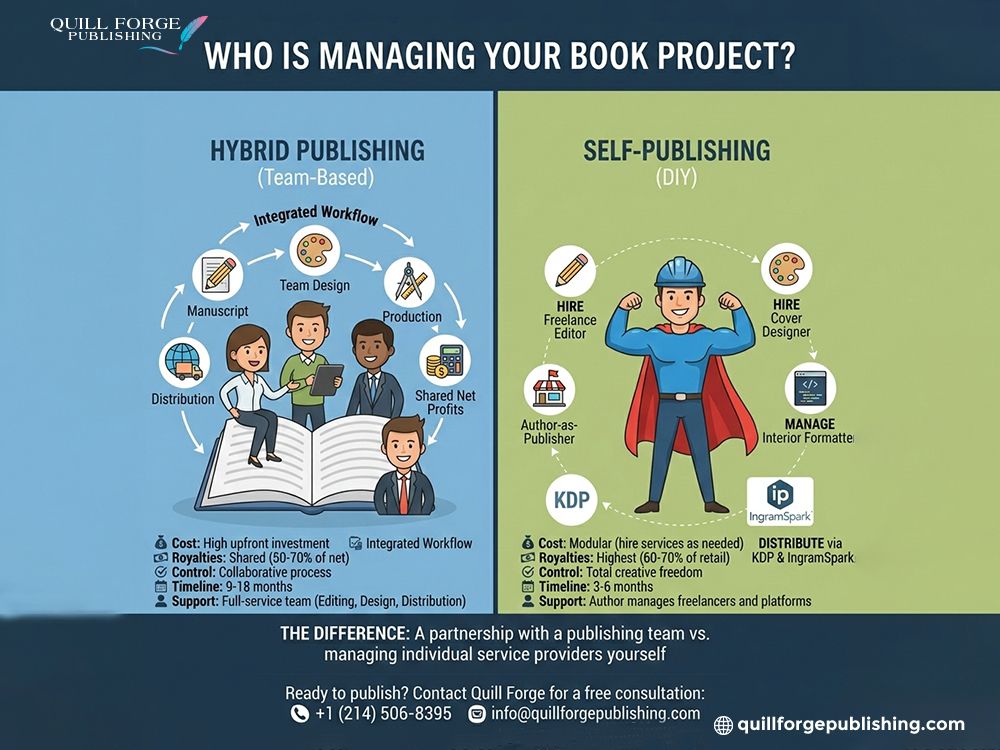
Understanding the difference between hybrid and self publishing affects your expectations, budget, and outcomes.
Hybrid publishing typically includes:
· Editorial curation that provides credibility through selective acceptance
· Comprehensive production handled by the publisher’s team
· Established distribution through existing retailer relationships
· Marketing support though extent varies significantly by publisher
· Royalty structure where you earn 50-70% rather than 100% of net proceeds
Self-publishing offers:
· Complete creative control over every aspect of your book
· Higher royalties per unit sold (typically 60-70% from retailers)
· Faster timeline without editorial approval processes
· Lower upfront costs if you handle some tasks yourself
· Full ownership of all publishing rights and assets
Neither path is inherently better. The right choice depends on your goals, budget, skills, and what you value most in the publishing process.
How to Identify Legitimate Hybrid Publishing Companies in USA
The hybrid publishing space includes both reputable publishers and predatory operations disguised as partnerships.
Legitimate hybrid publishing companies in USA demonstrate:
· Selective acceptance of manuscripts based on quality, not just payment ability
· Transparent pricing with clear explanations of what services are included
· Author-favorable contracts where authors retain rights and receive fair royalties
· Professional production standards comparable to traditional publishers
· Established distribution through major wholesalers and retailers
· Verifiable track record with published authors who achieved success
Red flags include:
· Accepting every manuscript without editorial review
· Unclear or hidden costs that escalate during the process
· Contracts that grant the publisher rights without corresponding obligations
· Promises of bestseller status or guaranteed sales numbers
· Pressure tactics or limited-time offers to sign quickly
Research any hybrid publisher thoroughly before committing. Talk to their published authors. Review their catalog. Verify their distribution claims.
Why Hybrid Publishing Cost vs Self Publishing Cost Varies Dramatically
The financial comparison between hybrid and self-publishing isn’t straightforward.
Hybrid publishers typically charge package fees ranging from a few thousand dollars to $20,000 or more. These packages bundle editing, design, production, distribution, and varying levels of marketing support.
Self-publishing costs depend entirely on what services you need and who you hire. You might spend $500 if you handle most tasks yourself, or $10,000+ for comprehensive professional services.
The key difference: hybrid publishing is usually upfront and all-inclusive, while self-publishing is modular and à la carte.
Neither approach is automatically cheaper. The question is which model gives you better value for your specific project and goals.
What Makes the Best Publishing Option for New Authors USA
For first-time authors trying to determine the best publishing option for new authors USA, consider these factors:
Choose hybrid publishing if:
· You want editorial validation and curated acceptance
· You prefer comprehensive services under one roof
· You value established distribution relationships
· You’re willing to invest significantly upfront
· You want guidance through the entire process
Choose self-publishing if:
· You want complete creative and business control
· You’re comfortable managing multiple service providers
· You want to maximize per-unit royalties
· You prefer modular costs over large upfront packages
· You have marketing skills or platform already
Neither path guarantees success. Both require investment, whether financial or time-based. The right choice aligns with your strengths, resources, and what you want from the publishing experience.
How Quill Forge Supports Both Publishing Paths
Whether you choose hybrid or self-publishing, professional support makes the difference between amateur and professional results.
Quill Forge’s publishing services work with authors on both paths:
For self-publishers, they provide comprehensive à la carte services including editing, design, distribution setup, and marketing support while you maintain full control and ownership.
For authors exploring hybrid models, their book coaching helps you evaluate publishers, understand contract terms, and make informed decisions about which hybrid publisher aligns with your goals.
Their team’s experience across both publishing models means they provide honest guidance rather than pushing you toward whichever option generates more revenue for them.
Why Distribution Matters Regardless of Publishing Path
Both hybrid and self-published books need proper distribution to reach readers beyond Amazon.
Distribution determines whether your book can be:
· Ordered by independent bookstores through standard wholesalers
· Acquired by libraries through their purchasing systems
· Stocked by chain retailers beyond Amazon
· Available internationally through global distribution networks
Hybrid publishers should provide this distribution automatically. Self-publishers must set it up themselves through services like IngramSpark or through comprehensive publishing packages.
Quill Forge’s distribution infrastructure ensures self-published authors access the same retail channels that hybrid publishers offer, leveling the playing field.
How Marketing Differs Between Models
Many authors choose hybrid publishing believing it includes robust marketing. This is often the biggest misconception.
Most hybrid publishers provide basic marketing support like press release distribution, social media setup, or author website templates. Very few invest in paid advertising or active publicity campaigns for individual titles.
Self-publishers who work with professional marketing & publicity services often achieve better promotional results because campaigns are customized to their specific book rather than templated across a publisher’s entire catalog.
Marketing success depends more on strategy, budget, and execution than whether you’re hybrid or self-published.
Start Your Publishing Journey with Clarity
The hybrid vs self-publishing decision isn’t about which path is universally superior. It’s about which approach aligns with your specific situation, goals, and resources.
Hybrid publishing offers structure, validation, and comprehensive services under one roof. Self-publishing offers control, flexibility, and potentially higher returns.
What matters most is understanding what you’re actually getting, what it costs, and whether those services deliver value for your book.
Your publishing path should support your vision, not complicate it. Work with professionals who help you make informed decisions rather than pressuring you toward one model because it benefits them.
Ready to explore your publishing options with honest guidance?
Book your free consultation with Quill Forge today and start your publishing journey with a team that supports both hybrid and self-publishing paths based on what’s actually best for your book.
Frequently Asked Questions
1. Is hybrid publishing the same as vanity publishing?
No. Legitimate hybrid publishers curate their lists and maintain quality standards. Vanity presses publish anything if you pay. The selective acceptance process differentiates true hybrid from vanity publishing.
2. Do hybrid publishers pay authors advances?
Typically no. Hybrid models require author investment upfront rather than publisher advances. Authors receive higher royalties to compensate for their financial contribution.
3. Can self-published books get into bookstores?
Yes, if properly distributed through wholesalers like Ingram. Self-published books with professional production and appropriate distribution access the same retail channels as hybrid or traditionally published titles.
4. How long does hybrid publishing take compared to self-publishing?
Hybrid publishing typically takes 9-18 months from contract to publication. Self-publishing can be much faster, sometimes 3-6 months, because you control the timeline.
5. Do I keep my rights with hybrid publishing?
It depends on the contract. Reputable hybrid publishers allow authors to retain rights. Always review contracts carefully before signing.
6. Which path is better for first-time authors?
Neither is universally better. First-time authors benefit from guidance either way. Hybrid provides structure; self-publishing offers flexibility. Choose based on your priorities and resources.
7. Can I switch from self-publishing to hybrid later?
Generally no for the same book, since you’ve already published it. But you can choose different paths for future titles based on experience with your first book.
8. Do hybrid publishers provide editing services?
Yes, editing is typically included in hybrid publishing packages. However, the extent and quality vary significantly between publishers.
9. How does Quill Forge help authors decide between options?
Quill Forge’s book coaching includes honest evaluation of your goals, resources, and project specifics to recommend the publishing path that makes most sense for your situation.
10. Is self-publishing respected in the industry now?
Yes. Professional self-publishing is widely respected in 2026. Quality matters more than publishing path. Readers care about the book, not how it was published.