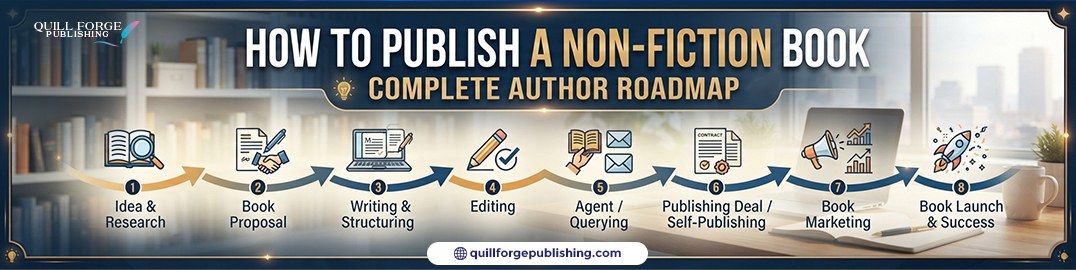
Publishing a nonfiction book involves 10 stages from idea validation to launch. The total timeline for a professionally published nonfiction title ranges from 6 to 14 months, depending on your writing pace and which publishing path you choose.
The 10 stages at a glance:
-
Idea validation & outline
-
First draft (2–6 months)
-
Self-edit & beta readers
-
Developmental editing (4–8 weeks)
-
Copy editing (2–4 weeks)
-
Proofreading (1–2 weeks)
-
Cover design (2–4 weeks)
-
Interior formatting (1–2 weeks)
-
Distribution setup
-
Launch & marketing (ongoing)
Cost to publish nonfiction professionally: $4,000 to $12,000 for a full-service approach covering editing, design, and distribution.
The question of how to publish a nonfiction book is deceptively simple on the surface. At its most basic, you write a manuscript, upload it to Amazon KDP, and it's published. But the difference between a book that's been published and a book that's been published well, professionally edited, correctly formatted, genre-appropriately designed, widely distributed, and positioned to find its readers, is the difference between a title that sells and one that doesn't.
This roadmap covers every stage of the nonfiction book publishing process in the order it happens: from outline to manuscript to editorial to design to distribution to launch. It explains what each stage involves, how long it realistically takes, what it costs, and how the best nonfiction publishers in the USA and professional self-publishing paths differ. Whether you're writing a business book, memoir, self-help title, or narrative nonfiction, this guide applies.
Key Takeaways
-
Nonfiction publishing is a 10-stage process. Skipping stages doesn't eliminate them, it just produces a less competitive book.
-
The most important stage most authors underinvest in is developmental editing: argument structure, pacing, and logical flow that copy editing doesn't address.
-
Realistic total timeline from outline to published book: 6 to 14 months, depending on writing pace and publishing path.
-
Realistic total cost for a professionally published nonfiction book: $4,000 to $12,000, covering editing, design, formatting, and distribution setup.
-
The self-publishing path gives you the highest royalties and full creative control, but requires you to source and manage every professional service independently. For a full breakdown of what that looks like, see our self-publishing costs guide.
-
A professional book publishing company coordinates the full process under one roof, reduces the management burden on the author, and ensures all stages are completed in the right order to platform specifications.
What Is the Complete Roadmap for Publishing a Nonfiction Book?
Here is every stage of the nonfiction publishing process, who handles it, and how long each stage realistically takes:
The total elapsed time from outline to published book is typically 8 to 14 months for an author writing alongside a full-time job, or 6 to 9 months for an author writing full-time. How long it takes to publish a nonfiction book depends primarily on the time you invest in the manuscript itself. The professional services downstream (editing, design, formatting) add 3 to 4 months regardless of your writing pace.
How Do You Start Publishing a Nonfiction Book? The Outline and Market Validation Stage
The starting point for every successful nonfiction book is not the first chapter, it's the outline and market validation. Before you write a word, you need to know three things: who exactly your reader is, what specific transformation or knowledge your book delivers, and what competing titles already exist in your category.
The nonfiction book outline: five essential components
-
Central premise in one sentence. What does your book argue, teach, or explore? If you cannot state it in a single sentence, the premise needs more development. Readers make buy decisions based on a premise, not a table of contents.
-
Target reader definition. Not "business professionals" but "first-time managers in tech companies navigating their first team." The more specific your reader definition, the more powerfully every chapter can speak to them.
-
Chapter-by-chapter structure. Every chapter should advance the book's central argument or narrative. Chapters that don't clearly serve the premise are structural problems that developmental editing will address, but catching them at outline stage is far cheaper.
-
Competing titles reviewed. Read the top 5 bestselling books in your exact Amazon category before writing. Know what's already been said, what's been said well, and what gap your book fills.
-
Author's unique authority. What experience, expertise, research, or perspective do you bring that the competing titles don't have? This should be articulable in two or three sentences and visible throughout the manuscript.
What Does a Nonfiction Book Editor Actually Do and Why Is It Non-Negotiable?
The editorial stage is where most nonfiction authors underinvest, and where the difference between a book that changes minds and one that gets read once and forgotten is most often determined. A nonfiction book editor is not primarily a grammar corrector, that's what a copy editor does. A nonfiction developmental editor evaluates:
-
Argument coherence. Does the book's central argument hold from first chapter to last? Does each section build on the previous one? Are there logical gaps or unsupported claims that undermine the author's credibility?
-
Chapter structure and pacing. Does each chapter earn its place? Are chapters ordered in the sequence that best serves reader understanding? Is the pacing appropriate: enough depth to be valuable, not so much that it loses the reader?
-
Reader experience. Will the target reader, the person who bought this book to solve a specific problem or gain specific knowledge, feel their need was met by the time they finish? This is the most important question any nonfiction editor asks.
-
Voice and authority. Does the author's expertise come through consistently? Are there sections where the prose becomes tentative, overly hedged, or inconsistent with the author's established voice?
After developmental editing comes copy editing (grammar, punctuation, continuity) and then proofreading (final pass before publication). The correct order, developmental first, copy second, proof last, is non-negotiable. Running copy editing on a manuscript that still needs structural work wastes money.
What Does It Cost to Publish a Nonfiction Book Professionally in 2026?
The cost to publish a nonfiction book professionally breaks down across five service categories. Here are realistic 2026 ranges for a full-length nonfiction title (50,000 to 80,000 words):
-
Developmental editing: $4,000 to $12,000. The largest single cost in nonfiction publishing and the most commercially important. Rate depends on manuscript length, complexity, and the editor's experience level. Genre-specialist editors with verified nonfiction credits are worth a premium.
-
Copy editing: $1,000 to $4,000. Typically $0.02 to $0.05 per word. Less expensive than developmental editing but essential, every nonfiction book needs a professional copy edit before publication.
-
Proofreading: $500 to $2,000. The final pass. Always necessary, even after two prior editing rounds.
-
Cover design: $400 to $1,500. Nonfiction covers are primarily typography-forward with strong author authority signals. A genre-matched professional cover is critical. Nonfiction readers make buy decisions differently from fiction readers, and the cover must communicate authority and clarity immediately.
-
Interior formatting: $300 to $800. Print and ebook formatting are different deliverables. Both are required for an author publishing across formats.
Total realistic budget for a professionally published nonfiction book: $6,000 to $20,000 for the full-service chain. Full-service publishing companies often bundle these services at a lower combined cost than sourcing each independently, and coordinate the handoff between stages so nothing falls through the cracks. For a full cost breakdown by category, see our self-publishing costs guide for 2026.
Which Publishing Path Is Right? Self-Publishing vs Using a Professional Book Publishing Company
For most nonfiction authors in 2026, the choice is between self-publishing with independently sourced services and using a professional book publishing company that coordinates the full process. The self-publishing path offers maximum royalty rates and direct control but requires the author to source, vet, manage, and coordinate every professional service independently. The full-service path costs more in service fees but delivers a coordinated, professionally managed process with less burden on the author.
What Are the Best Nonfiction Publishers in the USA for Self-Published Authors?
The best nonfiction publishers for self-published authors in 2026 are not the Big Five traditional publishers, those that require agent representation and offer lower royalties. The strongest options for authors who want professional results while retaining rights and royalties are:
-
Amazon KDP. For ebook and Amazon print distribution. Free setup, up to 70% ebook royalties, Prime-eligible print. Best Amazon placement. Essential for any nonfiction author selling on Amazon.
-
IngramSpark. For wide print distribution to bookstores, libraries, and international retailers. The distribution network that professional publishers use. $49 setup fee per title, but access to 40,000+ retail partners makes it essential for nonfiction authors targeting bookstore placement and library adoption.
-
Draft2Digital. For wide ebook distribution to Apple Books, Kobo, Barnes & Noble, Scribd, OverDrive, and 40+ other platforms. No upfront fees. Ideal for nonfiction authors who want library and subscription platform reach beyond Amazon.
-
Full-service publishers like Quill Forge. For authors who want KDP, IngramSpark, and wide ebook distribution coordinated under one publishing plan, with editing, design, and formatting handled to platform specifications. Authors retain full rights and earn high net royalties.
How Long Does It Take to Publish a Nonfiction Book from Start to Finish?
How long it takes to publish a nonfiction book is one of the most common questions authors ask, and the answer has two parts: how long it takes to write the manuscript (which is entirely the author's variable) and how long the professional publishing process takes downstream (which is largely fixed).
Writing timeline estimates for nonfiction:
-
Author writing full-time: 2 to 4 months for a 60,000 to 80,000-word manuscript
-
Author writing part-time alongside other work: 4 to 9 months
-
Author using a ghostwriter: 12 to 20 weeks from first interview to manuscript delivery
Professional publishing pipeline (editing → design → formatting → distribution setup): 3 to 4 months
Total realistic timeline: 6 to 9 months for a full-time author, 9 to 14 months for a part-time author, 6 to 9 months with a ghostwriter. Traditional publishing adds 12 to 24 months from acquisition to publication on top of the writing timeline, making self-publishing the significantly faster path to market.
Have Questions About Publishing a Nonfiction Book? Here's How to Get Started
Whether you're at the outline stage, halfway through a manuscript, or holding a completed draft and not sure what to do next, a free 30-minute consultation with the Quill Forge Publishing team gives you a clear picture of the publishing process ahead, what it realistically costs, and which path fits your goals and timeline.
We work with nonfiction authors at every stage, from market validation and manuscript development through to final publication and global distribution. We're happy to give you an honest assessment of where your manuscript stands and what the next step actually is.
-
Nonfiction developmental editing from specialists with verified business, memoir, and self-help publishing credits
-
Genre-matched nonfiction cover design built to communicate authority and convert at thumbnail size
-
Print and ebook formatting to KDP and IngramSpark specifications
-
Global distribution to 60,000+ bookstores, libraries, and online retailers
-
Book marketing including ARC campaigns, launch strategy, and Amazon Ads management
📞 +1 (512) 380-1661
📧 info@quillforgepublishing.com
🌐 www.quillforgepublishing.com
Frequently Asked Questions:
1. What is the first step in publishing a nonfiction book?
The first step is market validation and outline development, not writing. Before committing to a full manuscript, confirm that your target reader exists and is actively looking for your book (through Amazon and Google Trends research), define your reader in a single specific sentence, and build a chapter-by-chapter outline with your central argument clearly stated. Starting with a validated outline ensures every chapter you write serves a commercially viable premise and a defined reader.
2. How much does it cost to publish a nonfiction book in 2026?
The cost to publish a nonfiction book professionally ranges from $4,000 to $20,000 depending on manuscript length and which services you source. A realistic breakdown: developmental editing ($4,000–$12,000), copy editing ($1,000–$4,000), proofreading ($500–$2,000), cover design ($400–$1,500), and interior formatting ($300–$800). Full-service publishing packages often bundle these at a lower combined cost than sourcing independently, with the added benefit of coordinated handoffs between stages.
3. What is the difference between self-publishing and using a nonfiction book publishing service?
Nonfiction book publishing services from a full-service company coordinate the complete publishing process, editing, design, formatting, distribution, and sometimes marketing, under one roof. Self-publishing means you source and manage each professional service independently (editor, designer, formatter, distributor). Self-publishing gives you maximum royalty rates and direct vendor relationships. Full-service publishing reduces your management burden and ensures all stages are completed in the correct order to professional standards.
4. How long does it take to publish a nonfiction book?
How long it takes to publish a nonfiction book depends on your writing pace plus the professional services pipeline. Writing a 60,000 to 80,000-word manuscript takes 2 to 9 months depending on how much time you can dedicate. The editorial, design, and distribution process downstream takes 3 to 4 months. Total realistic timeline: 6 to 9 months for a full-time author, 9 to 14 months for a part-time author. Traditional publishing adds 12 to 24 months from acquisition to publication on top of these timelines.
5. Do I need a literary agent to publish a nonfiction book?
Only if you want to pursue traditional publishing with major publishers, most of whom require agent representation to consider submissions. For self-publishing, full-service publishing, or hybrid publishing, no agent is required or relevant. If traditional publishing is your goal, agent representation is the path, but understand that landing an agent for nonfiction typically requires a strong book proposal, an existing author platform, and credentials relevant to your subject matter.
6. What does a nonfiction book editor actually do?
A nonfiction book editor at the developmental level evaluates argument structure, chapter organisation, pacing, logical coherence, and reader experience, the big-picture elements that determine whether the book delivers on its premise. A copy editor handles grammar, punctuation, continuity, and fact consistency. A proofreader catches final errors before publication. All three stages are necessary for a professionally published nonfiction book, in that order. Developmental editing is the most transformative and the stage most frequently skipped by authors who underestimate what it addresses.
7. What is the best way to self-publish a nonfiction book?
The strongest self-publishing approach in 2026 combines: Amazon KDP for Amazon ebook and print distribution, IngramSpark for wide print distribution to bookstores and libraries, and Draft2Digital for wide ebook distribution to Apple Books, Kobo, and library platforms. Source professional editing, cover design, and formatting independently or through a full-service publisher. Plan your ARC campaign and launch strategy at least 6 weeks before publication. Build your email list before launch, not after.
8. What are the best nonfiction publishers in the USA for self-published authors?
The best nonfiction publishers for authors who want to retain rights and earn high royalties are: Amazon KDP (essential for Amazon presence), IngramSpark (essential for bookstore and library distribution), and full-service companies like Quill Forge Publishing that coordinate the complete publishing process. Traditional publishers offer prestige and zero upfront cost but take 85 to 92% of royalties and involve 18 to 36 month timelines. For most nonfiction authors with a defined platform and a specific reader, the self-publishing path offers significantly better economics.
9. How do I choose between different nonfiction book publishing services?
Evaluate nonfiction book publishing services on four criteria: editorial quality (ask to see the specific editor's credentials and verify their nonfiction credits), distribution reach (do they set up KDP, IngramSpark, and wide ebook distribution?), royalty structure (what percentage do you keep on every channel, clearly stated in writing?), and rights retention (do you keep full copyright?). Any service that can't clearly answer all four of those questions in writing before you sign is not the right partner.
10. Does Quill Forge Publishing offer nonfiction book publishing services?
Yes. Quill Forge Publishing offers comprehensive nonfiction book publishing services including developmental editing, copy editing, proofreading, genre-matched cover design, interior formatting, and global distribution across Amazon KDP, IngramSpark's 40,000+ retail and library network, and 40+ wide ebook platforms. Authors retain full copyright and earn high net royalties on every sale. We also offer ghostwriting, book coaching, audiobook production, and book marketing services. Call +1 (512) 380-1661 or visit quillforgepublishing.com for a free consultation.