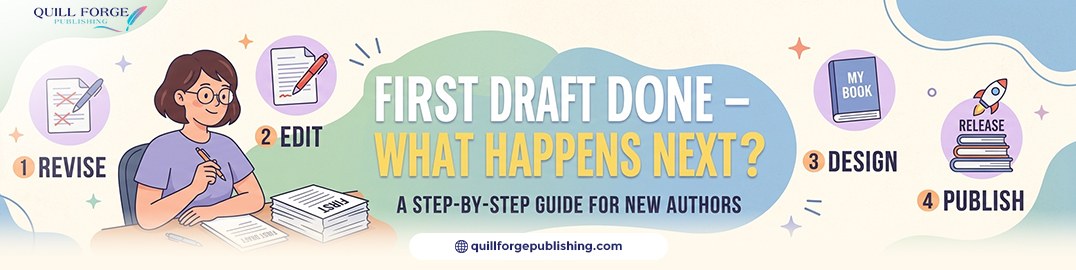
You typed the last sentence. You closed the laptop. For about forty-eight hours, you felt great.
Then the question hit: now what?
Finishing a first draft is a genuine milestone — most people who start a book never get there. But the first draft is not a book. It's raw material. What happens between that last sentence and a published title is a defined, sequential process, and most authors either rush it, skip steps, or don't know what the steps are.
This guide is your book publishing checklist from draft to launch. It covers everything you need to know about what to do after finishing a manuscript USA authors face — from the self-editing pass to professional editing, cover design, formatting, distribution, and marketing. Follow it in order and your book will be ready to compete with anything on the shelf.
The First Thing to Do With a Finished First Draft: Step Away
Before you do anything else before you reread it, share it, or start editing put the manuscript away for at least one to two weeks. This is not optional advice. It's the most important thing you can do for the quality of what comes next.
When you've been inside a manuscript for months, your brain auto-corrects as you read. You see what you intended to write, not what's actually on the page. You miss plot holes because you know the context. You overlook flat dialogue because you hear how you meant it to sound. Distance fixes this. Two weeks of not looking at your manuscript gives you the objectivity to read it as a reader — not as its author.
Use the time to read in your genre, rest, or start planning the next book. When you come back to the manuscript, you'll see it clearly for the first time.
Next Steps After First Draft: Your Full Book Publishing Process for Writers Texas Market and Beyond
Here is the complete book publishing checklist — every stage from fresh draft to published title, in the order they must happen:
Every stage in this table is necessary. Authors who skip steps especially professional editing and cover design — consistently underperform against authors who follow the full process. The temptation to publish quickly is real, but a rushed launch is far harder to recover from than a delayed one.
The Self-Edit Pass: What to Do After Writing a Book Before Anyone Else Reads It
Your first self-edit pass is not about perfecting the manuscript — it's about making it ready for other eyes. Read the entire draft from beginning to end without stopping to fix individual sentences. You're looking for the big things: structural problems, missing scenes, character inconsistencies, pacing issues, chapters that don't serve the story.
As part of your self publishing workflow for new authors, ask yourself these questions during your self-edit:
-
Does every chapter move the story or argument forward? If not, why is it there?
-
Are the opening pages strong enough to hold a reader who didn't write the book?
-
Does the ending earn what the opening promises?
-
Are there scenes, chapters, or sections you skipped past while reading? Those are the slow parts.
-
Does every character serve a clear purpose and behave consistently?
Make a list of everything that needs attention. Then go back and address the list. This pass typically takes one to two weeks depending on manuscript length. When you're done, the manuscript is ready for beta readers.
If you're not sure whether your manuscript needs structural support beyond what a self-edit can fix, this guide on the difference between a book coach and an editor can help you figure out which one you actually need at this stage.
Beta Readers: The Most Underused Step in the Book Publishing Process for Writers USA Market
Beta readers are your test audience — real readers in your target genre who read your manuscript before publication and give you honest feedback. They are not editors, they are not proofreaders, and they should not be your friends or family members who will tell you it's great regardless of the truth.
Find beta readers through genre-specific communities on Facebook, Reddit (r/BetaReaders), or writing forums. Aim for three to five readers who actively read in your genre. Give them a clear brief: you want feedback on pacing, character, plot, and overall engagement — not line-level edits. Set a deadline of two to four weeks.
Beta reader feedback tells you what a professional editor will confirm. If three out of five beta readers flag the same chapter as slow, that chapter needs work before it goes to your editor. Addressing major structural issues before the professional edit saves you money and rounds of revision.
Post First Draft Editing Services USA: What Professional Editing Actually Covers
After self-editing and beta reader feedback, your manuscript goes to a professional editor. This is the most important investment you will make in your book, and it comes in three stages:
-
Developmental editing: Big-picture structure, pacing, plot, and character. This is the first professional edit and the most transformative. A developmental editor catches what beta readers miss and what you've become blind to.
-
Copy editing: Grammar, punctuation, spelling, continuity. This happens after all structural revisions are complete. Running copy editing on a manuscript that still needs developmental work wastes your money.
-
Proofreading: The final pass for typos and formatting errors. This happens after the manuscript is formatted and before it goes to the distributor. Every book needs a proofreader, even after two previous editing rounds.
For post first draft editing services USA authors can trust, look for genre-specialist editors with verifiable indie publishing credits. Always request a sample edit before signing a contract.
Cover Design, Formatting & Distribution: The Final Self Publishing Workflow for New Authors
Once editing is complete, three things happen before your book is live: cover design, interior formatting, and distribution setup. Each is a professional task, not a DIY shortcut.
Cover design. Your cover is the primary sales tool for your book. In a digital storefront, it's a thumbnail that has to compete against every other title in your genre. Professional cover designers who specialize in your genre know exactly what visual signals readers respond to. A beautiful cover that doesn't fit genre conventions will underperform against a simpler cover that does.
Interior formatting. Print and ebook formatting are different disciplines. Print formatting requires precise control over margins, gutters, headers, fonts, and page count. Ebook formatting requires clean, reflowable code that renders correctly across Kindle, Apple Books, Kobo, and every other reading device. Both formats need professional attention, especially for books with images, charts, or complex layouts.
Distribution setup. As part of a complete manuscript to published book process guide, your distribution strategy determines who can buy your book and where. Amazon KDP handles Amazon ebook and print sales. IngramSpark handles wide print distribution to bookstores and libraries. Draft2Digital handles wide ebook distribution across 40+ retailers. Most authors use all three for maximum coverage.
What to Do After Finishing a Manuscript USA Authors Often Get Wrong: The Most Common Mistakes
These are the mistakes that cost authors months of time, hundreds or thousands of dollars, and often significant damage to their book's long-term performance:
-
Publishing the first draft. A first draft is never ready to publish. No exceptions. Every author — at every level — revises, edits professionally, and proofreads before publication.
-
Skipping professional editing to save money. The cost of editing is recoverable. The cost of publishing an unedited book — in bad reviews, low sales, and damaged author credibility — is not.
-
Using a generic or DIY cover. Readers judge books by their covers, especially online. A cover that doesn't match genre expectations signals to every potential buyer that the book is self-published in the worst sense of the word.
-
Rushing to launch without a plan. A book with no marketing plan sells to nobody except people who already know the author. Launch strategy — ARCs, review campaigns, email lists, social proof — needs to be built before the book goes live, not after.
-
Ignoring the backmatter. The last pages of your book are valuable real estate. An author bio, a call to action for reviews, links to your next book, and an email signup link all belong in the backmatter of every book you publish.
Ready for the Next Step? Quill Forge Covers Your Complete Book Publishing Checklist
At Quill Forge Publishing, we work with authors at every stage of the process — from fresh first draft to published, marketed title. Whether you need developmental editing, cover design, formatting, global distribution, or a full-service publishing package that handles everything, we've built the infrastructure so you don't have to.
-
Professional editing at every level — developmental, line, copy, and proofread
-
Genre-matched cover design built for your specific market
-
Print and ebook formatting to every major platform's specifications
-
Global distribution setup across Amazon KDP, IngramSpark, and 40+ retailers
-
Book marketing services including ARC campaigns, launch strategy, and ongoing promotion
You wrote the book. We'll help you publish it the right way.
+1 (512) 380-1661 info@quillforgepublishing.com www.quillforgepublishing.com
→ Get Your Free Publishing Consultation: quillforgepublishing.com/contact-us
Frequently Asked Questions
1. How long should I wait before editing my first draft?
Wait at least one to two weeks before you read your manuscript again. The distance gives you objectivity — you'll read what's actually on the page instead of what you intended to write. Many authors wait four weeks or more, especially after a particularly intense writing period. The longer the rest, the fresher your eyes when you return.
2. Do I need beta readers if I'm already hiring a professional editor?
Yes. Beta readers and professional editors serve different purposes. Beta readers give you reader-level feedback on engagement, pacing, and emotional impact — the same feedback your actual audience will have. A professional editor gives you craft-level feedback on structure, prose, and technical execution. Both are valuable, and beta reader feedback before the professional edit can save you significant money by catching major structural issues first.
3. What is the correct order of the book publishing process?
The correct order is: rest the manuscript → self-edit pass → beta readers → developmental editing → copy editing → proofreading → cover design → interior formatting → distribution setup → launch and marketing. Each step must be completed before moving to the next. Skipping steps — especially any of the editing stages — compounds into larger problems at publication.
4. How much does the full book publishing process cost?
Costs vary by manuscript length, genre, and the services you choose. For a full-length novel (80,000 words), a realistic budget for professional editing, cover design, and formatting runs $3,000–$7,000 depending on the level of editing required and the complexity of the cover. Full-service publishing packages from companies like Quill Forge Publishing bundle these services at a more cost-effective rate than sourcing each provider independently.
5. When should I start thinking about marketing my book?
Start thinking about marketing the moment you begin editing. Your launch strategy — who your readers are, where they spend time, how you'll reach them — informs decisions you make during editing, cover design, and formatting. Here's a closer look at exactly when to start. ARC (Advance Review Copy) campaigns should be running 4–6 weeks before launch. By the time your book is live, you should already have reviews, email subscribers, and a promotional plan in place.
6. What is an ARC and do I need one?
An ARC (Advance Review Copy) is a pre-publication version of your book sent to readers in exchange for honest reviews at launch. ARCs are one of the most effective tools for building social proof before your book goes live. A book that launches with 20–50 honest reviews converts significantly better than a book that launches with zero. For any author serious about a strong launch, ARC campaigns are a non-negotiable part of the book publishing checklist.
7. Do I need all three distribution platforms — KDP, IngramSpark, and Draft2Digital?
Most professional indie authors use all three for maximum coverage. KDP handles Amazon ebook and print sales with the best Amazon placement and Prime eligibility. IngramSpark handles wide print distribution to bookstores, libraries, and international retailers. Draft2Digital handles wide ebook distribution across 40+ platforms including Apple Books, Kobo, and library systems. Each serves a different distribution channel that the others don't fully cover.
8. How do I know if my manuscript needs developmental editing or just copy editing?
If your manuscript is a first or second draft, it almost certainly needs developmental editing first. Developmental editing addresses structure, pacing, plot, and character — the big-picture elements that copy editing doesn't touch. If your manuscript has been through multiple revision rounds and beta readers have confirmed the structure is solid, you may be able to move directly to copy editing. When unsure, commission a professional editorial assessment before committing to a specific editing package.
9. Can I self-publish without a professional cover designer?
Technically yes. Practically, it's one of the most damaging decisions you can make for your book's sales. In digital storefronts, your cover competes as a thumbnail against thousands of professionally designed titles in your genre. Readers make buy decisions in under three seconds based largely on the cover. A DIY or template cover that doesn't fit genre conventions signals immediately that the book may not meet professional standards — and readers move on without clicking.
10. What should I include in my book's backmatter?
Your backmatter is valuable real estate that most authors underuse. Include: a call to action for readers to leave a review (be specific about where); a link to your next book or your author website; an email list signup with a free bonus (a short story, bonus chapter, or resource guide); an author bio with social media links; and acknowledgements if appropriate. A well-constructed backmatter turns one-time readers into ongoing fans and significantly improves your review conversion rate.