You have spent months, maybe years, on your manuscript. Now it is time to share it, and the first thing anyone reads is your opening. Not the middle, not the ending. The first three chapters.
For a literary agent, they are the entire submission. For a professional book editor, they are the sample that reveals whether the manuscript is structurally sound. For a reader browsing Amazon, they are the “Look Inside” preview that decides whether the book gets purchased or passed over.
Understanding what editors look for in a manuscript is one of the most practically useful things any author can know before submitting for manuscript editing services or traditional publication. In this guide, you will learn exactly what editors check, what they flag, and how to fix the most common problems before anyone else sees them.
Editors, including both literary agents and professional manuscript editors, use the first three chapters to answer one question:
Is this book ready to compete in its market?
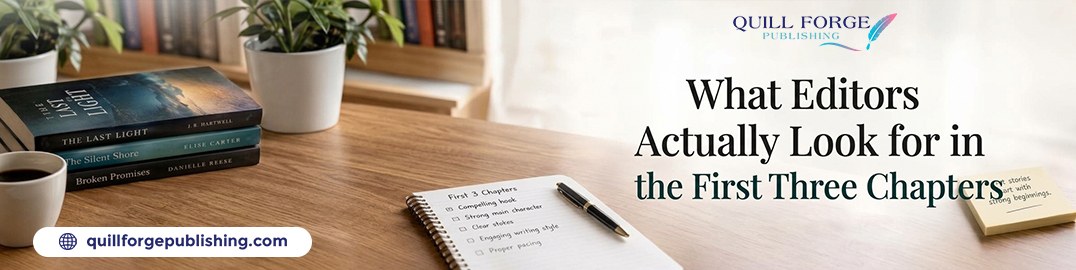
What they are specifically evaluating:
-
Does the opening hook earn the reader’s attention on the first page?
-
Is the voice consistent, distinctive, and genre appropriate?
-
Is the premise clear? Does the reader know what the book is about?
-
Is the pacing right for the genre, neither too slow nor rushed?
-
Are there structural or prose problems that signal a manuscript not ready for publication?
The first three chapters are your audition. They set the standard for everything that follows.
Key Takeaways
-
The first page is not a warm up. It is the audition. Editors decide within the first 250 words whether the manuscript has professional potential.
-
Publishers do not expect perfection. They look for evidence that the author has control of their craft and their story.
-
Voice, pacing, and premise clarity matter more in the opening chapters than anywhere else in the manuscript.
-
Common opening chapter problems such as slow starts, head hopping, and overwriting appear in almost every unedited submission.
-
A manuscript evaluation of your first three chapters is the most cost effective professional investment you can make before a full edit or submission.
What Does a Professional Book Editor Look for on the Very First Page?
The first page is where most manuscripts lose their reader, and where most editors make their first judgment.
A professional editor reads the first page asking:
-
Is there a reason to keep reading? Not a promise of something interesting later, but something interesting now.
-
Is the voice distinctive enough to carry 300 pages? Or does it sound like every other manuscript in this genre?
-
Is there a grounding presence? Does the reader know where they are, who they are with, and roughly what kind of book this will be?
A strong opening does not need to begin with action. It needs to begin with interest. That can be a compelling voice, an intriguing situation, a vivid setting, or a question the reader immediately wants answered.
What kills a first page:
-
Starting with weather, waking up, or a long description of a character’s appearance in a mirror
-
An opening that could belong to any book in the genre, with nothing specific and nothing distinctive
-
Telling the reader how to feel before they have had a chance to feel anything
These are classic first time author mistakes, and every one of them can be fixed with the right feedback.
What Do Editors Look for in a Manuscript’s Voice and Consistency?
Voice is the element most difficult to teach and easiest to identify. Editors know within a paragraph whether a manuscript has a distinctive, controlled voice or whether the prose is generic.
In the opening three chapters, editors look for:
-
Consistency. Does the voice stay the same from page 1 to page 30? Or does it drift, formal in one paragraph and casual in the next?
-
Genre appropriateness. A literary fiction voice in a thriller reads as wrong. A breezy, fast paced voice in a quiet literary novel reads as wrong. Voice must match reader expectations for the genre.
-
Point of view control. Head hopping, which means shifting between character perspectives without clear scene breaks, is one of the most common problems in unedited manuscripts. Each chapter should have a clear, consistent POV.
Voice problems in the opening chapters signal to an editor that the manuscript will have the same problems throughout. It is not a cosmetic issue. It is a structural signal. If your voice feels uncertain, book coaching can help you find and strengthen it before editing begins.
What Do Publishers Look for in a Manuscript’s Premise and Pacing?
By the end of the third chapter, any editor, whether evaluating for acquisition or for manuscript editing, should be able to answer two questions without having to guess:
-
What is this book about? (The premise)
-
Why should I keep reading? (The narrative or informational promise)
If those questions are not answerable after three chapters, the opening has a structural problem.
For fiction: The inciting incident, the event that disrupts the protagonist’s normal world and sets the story in motion, should land no later than the end of chapter two for most commercial genres. Literary fiction has more latitude, but even there, readers need to know what kind of journey they are on.
For nonfiction: The central argument, the reader’s problem, and the book’s promise should all be established in the introduction and first chapter. If a reader finishes chapter three without knowing what the book will teach them, the structure needs work. A strong book proposal forces you to define all of this clearly.
On pacing: Editors also flag openings that are too fast. A manuscript that rushes past character, setting, and relationship to get to plot events leaves readers without the investment they need to care about what happens next.
How Do Editors Perform a Manuscript Evaluation on the Opening Chapters?
A professional manuscript evaluation of the first three chapters is not a line by line edit. It is a diagnostic read that identifies patterns.
The editor is looking for:
-
Recurring prose habits. Overuse of adverbs, passive voice, filtering (“She noticed that...”, “He felt that...”), and telling instead of showing. If these appear consistently in the opening, they appear consistently throughout.
-
Structural red flags. Backstory dumps in chapter one, chapters that do not advance story or argument, POV inconsistencies, and pacing mismatches with genre.
-
Technical issues. Dialogue punctuation errors, tense inconsistencies, and inconsistent character names or physical descriptions.
-
Market readiness. Does this manuscript read like the published books in its category? Or does it read like a strong draft that has not been through professional editorial work?
The findings from those first three chapters inform the scope of the full edit: what stages are needed, in what order, and what the author must address first. If you are unsure which stage you need, this guide on manuscript editing vs proofreading explains the difference.
What Do the Opening Chapters Reveal About Whether a Manuscript Review Is Needed?
One of the most useful things a manuscript review of the first three chapters does is answer the question authors most want answered: is this ready?
Here is what the opening chapters reveal that the rest of the manuscript confirms:
-
If the first chapter starts slow, the manuscript has a pacing problem throughout.
-
If the voice is inconsistent in three chapters, it will be inconsistent in thirty.
-
If the premise is not clear by chapter three, the structure needs significant work.
-
If the prose has the same two or three recurring problems on every page, those problems are habits, not one off errors.
Most professional editors will tell you that reading 50 pages of a manuscript tells you almost everything you need to know about the full 300. The opening chapters are a representative sample, not an isolated section. Not sure where you stand? Check these signs your manuscript needs editing before you submit.
What Common Problems Do Book Editing Services Find Most Often in First Chapters?
After thousands of manuscript editing engagements, the same patterns appear in unedited first chapters regardless of genre or author experience:
-
The slow start. Setup that exists to reassure the author before the story begins. Readers do not need the setup. They need a reason to care.
-
The information dump. Three pages of backstory or worldbuilding before anything happens. The rule: earn the backstory by first making the reader care about the character.
-
The camera problem. Description that reads like a film camera panning a scene rather than a character experiencing it. Readers read for experience, not cinematography.
-
Telling emotions instead of showing them. “She was terrified” tells the reader. “Her hands would not stop shaking” makes them feel it. The difference is craft.
-
Overwriting. Sentences so dense with imagery, adjectives, or qualifications that the prose becomes exhausting before the story begins.
-
No stakes. The opening chapters feel pleasant but inconsequential. Nothing is at risk, and the reader has no reason to worry about the protagonist.
Every one of these is fixable. Fixing them requires recognising them first, which is precisely what a professional editorial assessment does. After a revision pass, use this first draft checklist to plan your next steps.
Have Questions About Your Opening Chapters? Here Is What to Do Next
If you are unsure whether your first three chapters are working, or you want a professional assessment before submitting to agents or commissioning a full edit, Quill Forge Publishing offers editorial assessments and free 1,000 word sample edits.
A sample edit of your opening pages shows you exactly how a professional editor reads your work, what they flag, and what needs to change before the full manuscript is ready. If you are still comparing options, this guide on how to find a book editor will help you choose with confidence.
-
Free 1,000 word sample edit: see exactly how your opening reads to a professional editor
-
Editorial assessment: a structured evaluation of your first three chapters with specific recommendations
-
Full manuscript editing: developmental, line, copy, and proofread
Phone: +1 (512) 380-1661
Email: info@quillforgepublishing.com
Website: www.quillforgepublishing.com/editing
Address: 5900 Balcones Drive, STE 30493, Austin, TX 78731
Frequently Asked Questions
1. What do editors look for in the first three chapters?
Editors look for a compelling hook, a consistent and genre appropriate voice, a clear premise, and the right pacing for the category. They are also identifying recurring prose habits that signal whether the manuscript is ready for professional publication or still needs developmental work.
2. How important is the first page to a professional editor?
Extremely. A professional book editor makes an initial judgment within the first 250 words. It is not a final judgment, but it is a strong initial read on whether the manuscript has voice, control, and something worth reading further. The first page sets the standard for everything that follows.
3. What do publishers look for in a manuscript submission?
A compelling opening, distinctive voice, clear premise, and evidence that the author can sustain quality over the full manuscript. For nonfiction, they also look for market positioning: who the reader is and what problem the book solves.
4. What is a manuscript evaluation?
A manuscript evaluation, or editorial assessment, is a structured professional read that identifies what a manuscript needs editorially: which stages, in what order, and what specific issues to address. It is typically 5 to 10 pages of written feedback and costs $200 to $600. You can view our editing pricing for current packages.
5. What are the most common problems editors find in first chapters?
Slow starts, backstory dumps, head hopping, telling emotions instead of showing them, and lack of clear stakes. These patterns appear in almost every unedited manuscript regardless of the author’s overall writing ability.
6. How do editors evaluate manuscripts differently from readers?
They read analytically, looking for patterns rather than plot. Where a reader notices something feels off, an editor diagnoses why it feels off and what needs to change. They also evaluate market readiness: not just whether the book is good, but whether it is ready to compete in its category.
7. Do literary agents read differently from developmental editors?
The criteria overlap significantly. Both ask: is there a compelling voice? Is this the right book for this market? Is it technically ready? Agents also evaluate commercial potential and their ability to sell the book. Developmental editors focus more purely on making the manuscript the best it can be.
8. How long should the first chapter be?
It depends on genre. Commercial fiction and thriller chapters are often 1,500 to 3,000 words and fast paced. Literary fiction chapters can be longer. Nonfiction introductions typically run 1,500 to 3,500 words. What matters more than length: does the chapter end with a reason to turn to the next one?
9. What is a manuscript review, and do I need one before submitting?
A manuscript review is a professional assessment of your manuscript’s readiness for submission, self publication, or a full edit. If you are unsure whether your manuscript is ready, a review of the opening three chapters is the most cost effective way to find out before spending on a full developmental edit.
10. Does Quill Forge Publishing offer manuscript evaluation and editing services?
Yes. Quill Forge Publishing offers editorial assessments, free 1,000 word sample edits, and full manuscript editing services from developmental through proofread. Call +1 (512) 380-1661 or visit quillforgepublishing.com/editing.