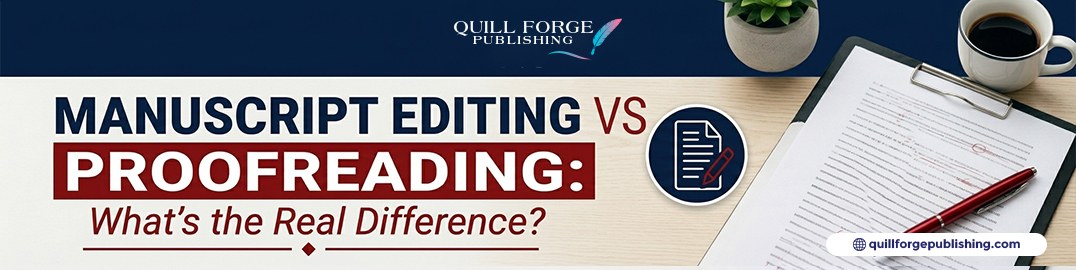
Editing and proofreading are not the same thing and doing them in the wrong order wastes money.
-
Editing fixes how your book is written (structure, clarity, flow, word choice)
-
Proofreading fixes what's wrong after editing (typos, punctuation, final errors)
The correct order: Edit first. Proofread last. Never reverse it.
Every book needs both. Skipping either stage shows up in reader reviews.
Ask ten authors what the difference between editing vs proofreading is and you'll get ten different answers. Most of them will be wrong.
The confusion is understandable. Both involve someone reviewing your manuscript. Both find problems. Both are necessary. But they target completely different types of problems at completely different stages and conflating them is one of the most expensive mistakes in self-publishing.
This guide explains manuscript editing vs proofreading clearly, when each happens, what our book editing services actually cover, and how to know which type of professional manuscript review your book needs right now.
Key Takeaways
-
Manuscript editing and proofreading are sequential stages — not interchangeable alternatives.
-
Editing comes first. Proofreading is always last.
-
A proofreader is not a substitute for an editor. A proofreader can't fix a structurally weak manuscript.
-
An editor is not a substitute for a proofreader. Editors miss final typos because they're focused on bigger problems.
-
Most books need at least two editorial stages: copy editing and proofreading. Many need three: developmental editing, copy editing, and proofreading.
What Is Manuscript Editing and What Does It Actually Cover?
Manuscript editing is an umbrella term that covers several distinct types of editorial work. Each targets a different level of the manuscript.
Developmental editing
The deepest, most transformative edit. A developmental editor looks at the big picture: structure, argument, pacing, character arc (fiction) or logical flow (nonfiction), and whether the book delivers on its premise. If you're still unsure your manuscript is structurally sound, working with a book coach before or alongside developmental editing can help you get there.
This is when to edit a book — after the first draft is complete and revised, before anything else. There's no point polishing sentences in a chapter that needs to be restructured. If you've just finished a draft, our guide on what to do after finishing your first draft walks through this exact decision.
Line editing
Works at the sentence and paragraph level. A line editor improves flow, clarity, tone, and word choice without rewriting your voice. The goal: your best writing, consistently, throughout the whole manuscript.
Copy editing
The mechanical precision edit. Grammar, punctuation, spelling, consistency, and continuity errors. This is what most people mean when they say "editing" but it's actually the third type, not the first.
All three are forms of book editing vs proofreading they happen before proofreading, in that order.
What Is Proofreading and When Do You Proofread a Book?
Proofreading is the final quality check before publication. It happens after all editing is complete and after the book has been formatted.
A proofreader catches:
-
Typos and spelling errors that slipped through editing
-
Punctuation inconsistencies
-
Formatting errors — wrong fonts, misaligned headings, incorrect page numbers
-
Word repetitions or missing words
-
Errors introduced during the formatting process itself
That last point is critical. Formatting a book introduces new errors. Even a perfectly edited manuscript can pick up typos and spacing issues during layout — this is exactly why our guide to formatting your book for Amazon KDP stresses proofreading only after formatting is locked, not before.
When to proofread a book: after editing is complete, after formatting is done, before any file goes to a printer or distributor.
How Does Editing vs Proofreading Compare Side by Side?
The most important takeaway from this table: neither service can replace the other. A proofreader working on an unedited manuscript is catching typos in prose that still has structural problems. An editor working on a formatted final file is focused on the wrong level of the manuscript.
Why Do Authors Confuse Book Editing vs Proofreading? The 3 Most Common Mistakes
Mistake 1: Sending the manuscript straight to a proofreader.
This is the most common and most costly mistake. A proofreader can clean up your typos. They cannot fix a chapter that doesn't work, an argument that doesn't land, or prose that's technically correct but difficult to read. The result: a polished version of an unedited book. If you're not sure which stage you actually need, our post on the signs you need a book coach instead of an editor can help you diagnose it before you pay for the wrong service.
Mistake 2: Asking an editor to also proofread.
Editors are focused on higher-level problems. When they're working on structure and clarity, they naturally overlook final-level errors. Expecting an editor to catch every typo is like asking a structural engineer to also paint the walls. Different focus, different eye.
Mistake 3: Proofreading before formatting.
If you proofread your Word document and then format it into a print-ready PDF, the formatting process introduces new errors. You've just invalidated your proofread. Always proofread the formatted file, not the raw manuscript — see our full self-publishing launch checklist for where this fits in the overall sequence.
What Do Book Editing Services Include and How Much Do They Cost?
Here's a realistic 2026 cost breakdown for each editorial stage for a standard 70,000–80,000 word manuscript:
-
Developmental editing: $0.08–$0.15 per word approximately $5,600–$12,000 for an 80k manuscript.
-
Line editing: $0.04–$0.09 per word — approximately $3,200–$7,200.
-
Copy editing: $0.02–$0.05 per word — approximately $1,600–$4,000.
-
Proofreading: $0.01–$0.025 per word — approximately $800–$2,000.
Most self-published books need at minimum copy editing plus proofreading. Books with structural issues need developmental editing first. Full-service packages that bundle multiple stages — like our standard publishing package or advanced publishing package — typically cost less than sourcing each stage separately. For a detailed line-item breakdown of everything else self-publishing involves, see our 2026 self-publishing cost guide.
What Does a Professional Manuscript Review Involve Before You Commit to a Full Edit?
If you're unsure what level of editing your manuscript needs, a professional manuscript review also called an editorial assessment is the right first step.
An editorial assessment is typically 5–10 pages of structured feedback covering:
-
The manuscript's overall strengths
-
The specific structural, prose, or consistency issues that need addressing
-
A recommended editorial roadmap — which stages to do, in what order
-
An honest evaluation of whether the manuscript is ready for copy editing or needs developmental work first
Cost: typically $200–$600 depending on manuscript length. It's the cheapest way to avoid paying for the wrong type of edit at the wrong time. You can also get a sense of this directly through a free book strategy call before committing to anything.
Have Questions About Which Edit Your Manuscript Needs?
If you're unsure whether your manuscript needs developmental editing, copy editing, proofreading, or all three — we can help you figure that out before you spend anything.
Quill Forge Publishing offers free 1,000-word sample edits and editorial assessments so you know exactly what your manuscript needs before committing to a full editing package.
-
Free 1,000-word sample edit — see the editor's style and depth before committing
-
Editorial assessment — a clear editorial roadmap for your specific manuscript
-
Full editing packages — developmental, line, copy, and proofread
Once your manuscript is edited and proofed, the next steps are cover design, book publishing, and book marketing — all of which we also handle in-house.
+1 (512) 380-1661 info@quillforgepublishing.com www.quillforgepublishing.com/editing 5900 Balcones Drive, STE 30493, Austin, TX 78731
Frequently Asked Questions:
1. What is the difference between editing and proofreading?
Manuscript editing fixes how your book is written structure, clarity, flow, word choice. Proofreading fixes what's wrong at the final stage: typos, punctuation, formatting errors. Editing comes first. Proofreading is always last.
2. Can a proofreader fix my manuscript instead of an editor?
No. A proofreader catches surface errors they can't fix structural problems, weak argument, or poor pacing. If your manuscript has editorial issues, proofreading will produce a cleaner version of an unedited book.
3. When should I edit my book?
When to edit a book: after you've completed a full draft and done at least one self-edit pass. Developmental editing comes first, then line or copy editing. Never send a first draft straight to a proofreader if you've just hit "The End," our first-draft-to-publication checklist lays out exactly what comes next.
4. When should I proofread my book?
When to proofread a book: after all editing stages are complete and after the book is fully formatted. Proofreading a pre-formatted manuscript means the formatting process will introduce new errors you won't catch.
5. Do I need both editing and proofreading?
Yes. Every book needs both. Editing improves the manuscript. Proofreading cleans the final version. Skipping either stage is visible to readers and shows up in reviews.
6. What does copy editing cover?
Copy editing covers grammar, punctuation, spelling, consistency, and continuity errors. It's the most mechanical of the book editing services it comes after developmental and line editing, before proofreading.
7. How much does professional book editing cost?
Developmental editing: $0.08–$0.15/word. Copy editing: $0.02–$0.05/word. Proofreading: $0.01–$0.025/word. For an 80,000-word book, expect $1,600–$4,000 for copy editing and $800–$2,000 for proofreading as a minimum investment.
8. What is a professional manuscript review?
A professional manuscript review (or editorial assessment) is a structured evaluation of your manuscript that identifies what it needs editorially and in what order. It costs $200–$600 and prevents you from paying for the wrong type of edit.
9. Can I proofread my own book?
Self-proofreading is unreliable because your brain auto-corrects what you intended to write. A professional proofreader reads what's actually on the page. For any book you intend to sell professionally, a professional final proofread is non-negotiable.
10. Does Quill Forge Publishing offer editing and proofreading services?
Yes. Quill Forge Publishing offers full book editing services developmental, line, copy, and proofread — with a free 1,000-word sample edit before you commit. Call +1 (512) 380-1661 or visit quillforgepublishing.com/editing.