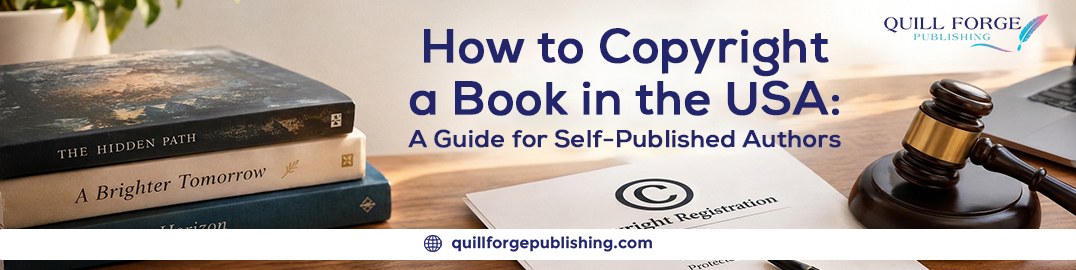
The moment you finish writing your book, you own it. Under US law, copyright protection is automatic. It exists from the instant your work is created in a fixed form. But automatic protection and registered protection are two very different things, and self published authors who do not understand the difference leave themselves exposed.
For copyright for self published authors, the question is not whether your book is protected, because it is. The real question is whether your protection is enforceable in a way that lets you recover damages if someone steals your work. That is where book copyright registration comes in.
Your options are straightforward: rely on automatic copyright (free, immediate, but limited in court), register with the US Copyright Office (low cost, gives you full legal protection and the ability to sue for statutory damages), or do both, which is what we recommend. Quill Forge Publishing guides authors through every administrative step of our book publishing services, including copyright, so nothing falls through the cracks. Call +1 (512) 380-1661 to get started.
Does Your Book Have Automatic Book Copyright Without Registration?
Yes, but with important limits.
Under the Copyright Act of 1976 and its subsequent amendments, copyright protection in the US is automatic from the moment of creation. Your book does not need a copyright notice, a registration number, or any official filing to be legally yours.
What automatic copyright gives you:
-
Legal ownership of the work from the moment of creation
-
The right to sue for actual damages if someone infringes
-
The right to stop infringing distribution
What automatic copyright does not give you:
-
The right to sue for statutory damages (which can range from $750 to $150,000 per work infringed)
-
The right to recover attorney’s fees in an infringement lawsuit
-
A public, searchable record of your ownership
-
Prima facie evidence of ownership, which a registration made within five years of publication provides
In short: without registration, you can prove you own your book, but winning meaningful compensation in court is much harder and more expensive.
How Do You Register a Copyright for a Book in the USA With the US Copyright Office?
The process for copyrighting a self published book through the US Copyright Office is straightforward and inexpensive. Here is how it works:
-
Go to copyright.gov. The US Copyright Office’s online registration portal is where you create an account and file your application.
-
Select the correct registration type. For a single author book, use “Literary Work: Single Work.” For an anthology or collection, the registration covers all included works.
-
Complete the application. You will provide the title, year of creation, publication status, and authorship information.
-
Pay the filing fee. As of 2026, the online registration fee for a single author, single work application is $45.
-
Submit a deposit copy. For an unpublished manuscript, you can upload a digital file. For a book published in print, you generally mail two copies of the best edition.
-
Receive your certificate. Processing typically takes several months for online registrations, though the effective date of registration is the date the Copyright Office receives your complete application, not when the certificate arrives.
The effective date of registration is what matters legally. If you register before someone infringes, you are entitled to statutory damages. Register after infringement and you can generally only claim actual damages, which are often minimal for a first time author. If you also need an identifier for your book, here is how to get a US ISBN.
When Should You Register, Before or After Publication?
Before publication, if possible.
The practical advice for how to copyright a book is to register as early as possible, ideally when your manuscript is complete and before you publish. Here is why:
-
If your book is registered before infringement occurs, you can claim statutory damages and attorney’s fees
-
If your book is infringed shortly after publication, a registration made within three months of first publication still qualifies for statutory damages
-
Early registration creates a timestamped, searchable public record of your ownership
For self published authors publishing through Amazon KDP or IngramSpark, the practical timeline is: complete your manuscript, register copyright, then format and publish. The $45 registration fee is one of the best investments in your publishing process. Add it to your self publishing checklist so it never gets skipped, or follow these steps to publish a book from draft to launch.
What Does the © Notice on Your Book Actually Do?
The copyright notice, written as © [Year] [Author Name], is not required by US law for works published after March 1, 1989, when the US joined the Berne Convention. But it is still strongly recommended.
What the notice does:
-
Tells readers and potential infringers that the work is protected
-
Removes the “innocent infringement” defence, so a defendant cannot claim they did not know the work was protected
-
Shows the year of first publication
For copyright for self published authors, your copyright page should include the © notice, the year of first publication, your name (or your publishing entity’s name), the statement “All rights reserved,” and your ISBN. Quill Forge Publishing includes a properly formatted copyright page in every book we produce. If you plan to format it yourself, read how to format your book for Amazon KDP.
How Long Does Book Copyright Last in the USA?
For works created after January 1, 1978, copyright lasts for the life of the author plus 70 years. After that, the work enters the public domain.
For works created by corporations or anonymous works, the term is 95 years from publication or 120 years from creation, whichever is shorter.
Practically speaking, if you are a living author publishing in 2026, your copyright will last well into the 22nd century. Your heirs can inherit and exercise your copyright. You can also transfer, license, or sell your copyright, though for most self published authors, retaining all rights is the financially sound choice.
Can You Copyright a Book in the USA If You Self Publish Under a Pen Name?
Yes. You have two options:
-
Register under your legal name. You have full legal standing, but keep in mind that Copyright Office records are public, so your legal name will appear in the record. You can list your pen name as well.
-
Register as an anonymous or pseudonymous work. The pen name is listed, not your legal name. The copyright term changes to 95 years from publication unless you reveal your identity in the Copyright Office records later.
Most pen name authors register under their legal name to preserve the full life plus 70 years copyright term and simplify estate planning.
What About How to Protect a Book Beyond Copyright Registration?
Copyright covers your specific expression, meaning the exact words you wrote. It does not cover your title, your genre, your plot idea, or your characters’ names (with narrow exceptions for highly distinctive characters).
Additional protection tools:
-
Trademark. If your book title becomes a series brand, you may want to trademark it. This is separate from copyright and protects the commercial use of the name.
-
Contracts. If you hire editors, illustrators, or ghostwriting services, make sure your contracts include work for hire clauses or copyright assignment so the work is unambiguously yours.
-
DRM (Digital Rights Management). For ebooks, platforms like Amazon KDP offer DRM options that technically restrict copying, though determined infringers can circumvent them. Compare IngramSpark vs KDP to see which platform fits your needs.
-
Watermarking. For advance review copies (ARCs), some authors use embedded watermarks to trace leaked copies.
Ready to Publish With Every Detail Handled Professionally?
Copyright guidance, ISBN acquisition, proper copyright page formatting, and global distribution: Quill Forge Publishing handles the administrative and production details so you can focus on writing.
-
Professional publishing from manuscript through market ready title
-
Full rights retained by you, always
-
Book distribution through Amazon KDP and IngramSpark across 40+ platforms
Phone: +1 (512) 380-1661
Email: info@quillforgepublishing.com
Website: quillforgepublishing.com
Address: 5900 Balcones Drive, STE 30493, Austin, TX 78731
Frequently Asked Questions
Q: Does my book have copyright protection without registration?
Yes. Book copyright is automatic under US law from the moment of creation. But without registration, you cannot sue for statutory damages or attorney’s fees, which are the most powerful remedies in an infringement case.
Q: How much does it cost to copyright a book in the USA?
The US Copyright Office fee for online registration of a single author, single work application is $45 as of 2026. This is the cost to copyright a book in the USA, and it is one of the most cost effective legal protections available. See the full self publishing costs breakdown for the rest of your budget.
Q: When should I register my copyright?
Before publication if possible. For book copyright registration, the earlier you register, the stronger your legal position. Registration within three months of publication still qualifies for statutory damages if infringement occurs after publication.
Q: What does copyrighting a self published book protect?
Your copyright protects your specific expression, meaning the exact text you wrote. It does not protect your title, plot idea, genre, or character names (with narrow exceptions). For title protection, trademark is the relevant tool.
Q: Can I copyright a book under a pen name?
Yes. You can register as a pseudonymous work, or under your legal name with the pen name listed. Registering under your legal name preserves the full life plus 70 years copyright term.
Q: Do I need a lawyer to register copyright?
No. The US Copyright Office’s online portal makes it straightforward to register a literary work yourself. If you have complex situations, such as multiple contributors, work for hire arrangements, or international rights, legal advice is worth considering. For a standard self published book, the process is designed for authors to complete independently.
Q: Does Quill Forge Publishing help with copyright registration?
We guide authors through the full publishing process, including copyright page setup and advising on registration. For the actual filing, authors complete it directly with the Copyright Office, which is a simple online process.