Amazon takes 30-65% of every book you sell through their platform. Apple, Barnes & Noble, and other retailers have similar cuts.
For every $15 book sold, you might see $3-5 in royalties after retailer commissions and printing costs.
But what if you could keep $10 or more per book by selling directly to readers?
Direct sales to your audience eliminate middlemen, maximize profit margins, and build direct relationships with the people who actually read your work.
The challenge is handling logistics that retailers normally manage: payment processing, order fulfillment, shipping, customer service, and inventory management.
Understanding how to sell books directly to readers requires balancing profit potential against operational complexity. Done right, direct sales become sustainable revenue streams. Done poorly, they create headaches that outweigh financial benefits.
Why Author Direct Distribution Strategy Makes Financial Sense
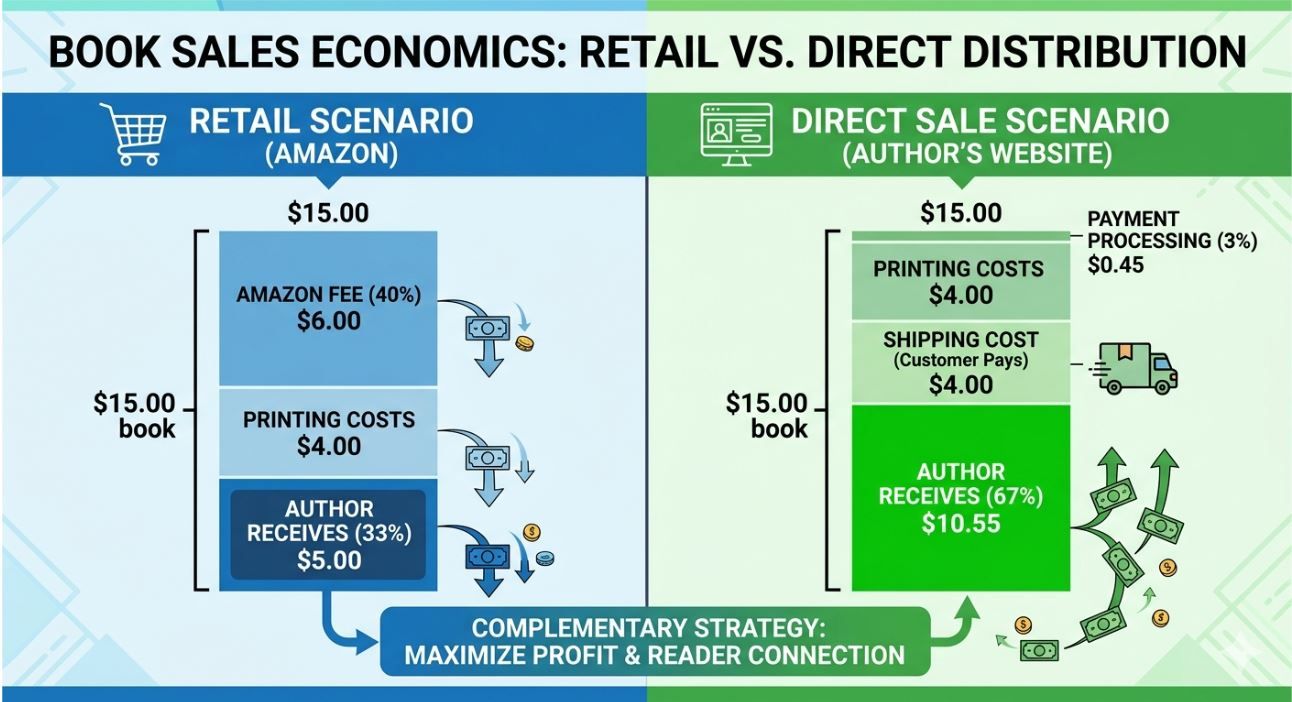
The economics of direct sales versus retail are compelling once you understand the math.
Retail scenario: $15 paperback on Amazon
· Amazon takes 40% ($6)
· Printing costs $4
· Author receives $5
Direct sale scenario: $15 paperback from your website
· Payment processing 3% ($0.45)
· Printing costs $4
· Shipping $4 (if you absorb it) or charged to customer
· Author receives $6.55 or $10.55 if customer pays shipping
The margin improvement is significant, especially at scale.
Author direct distribution strategy isn’t about replacing retailers entirely. It’s about building complementary sales channels that improve overall profitability while strengthening reader relationships.
How to Set Up Direct Sales Infrastructure
Selling books directly requires systems handling transactions, fulfillment, and customer support.
Essential infrastructure includes:
E-commerce platforms like Shopify, WooCommerce, or specialized author platforms handling payment processing and order management.
Print-on-demand integration through services printing and shipping individual orders without requiring inventory investment.
Shipping logistics either handled by POD fulfillment or managed separately if you maintain inventory.
Customer service systems responding to order issues, shipping questions, and returns.
Email marketing platform capturing customer data and enabling repeat sales.
Self publishing distribution services that include direct-to-reader options handle these technical components so authors focus on marketing rather than operational logistics.
Why Print-on-Demand Makes Direct Sales Viable
Historically, direct sales required authors to purchase inventory upfront, store boxes of books, and fulfill orders manually from their garage.
Modern book printing and distribution services changed this through print-on-demand fulfillment.
POD direct sales work by:
Integrating your store with print providers who fulfill individual orders automatically.
Eliminating inventory risk since books print only when ordered.
Automating fulfillment so you never touch physical books.
Scaling effortlessly whether you sell 5 books monthly or 500.
The per-unit cost is higher than bulk printing, but the elimination of inventory investment and fulfillment labor makes POD practical for most authors.
How to Market Direct Sales Without Competing with Retailers
Many authors worry that selling directly competes with retail partners and damages those relationships.
Smart author direct distribution strategy positions direct sales as complementary, not competitive:
Exclusive editions like signed copies, special formatting, or bonus content available only through your site.
Bundles and packages combining multiple books at discounts unavailable through retailers.
Merchandise combinations pairing books with author swag, bookmarks, or themed items.
Pre-orders offering early access to new releases before retail availability.
Personalization like signed bookplates or custom dedications impossible through retail channels.
These differentiators give readers reasons to buy directly without undercutting retail pricing or availability.
Why Email Lists Convert Better Than Social Media for Direct Sales
Building direct sales channels requires owning your audience relationship, not renting it from platforms.
Email marketing for direct sales outperforms social media because:
You own the list, not Facebook or Instagram who control algorithmic reach.
Open rates for engaged readers often reach 30-40%, far exceeding social media organic reach.
Purchase intent is higher when readers actively subscribe to hear about your books.
Segmentation capabilities let you target messaging to specific reader interests.
Automation nurtures relationships and promotes new releases without constant manual effort.
Book distribution services for authors that include marketing support help build and leverage email lists effectively for sustainable direct sales.
How Quill Forge Supports Author Direct Distribution
Setting up e-commerce infrastructure, integrating fulfillment, managing customer service, and marketing direct sales creates overwhelming complexity for most authors.
Quill Forge’s book distribution service includes comprehensive direct-to-reader support:
Their publishing infrastructure connects with print-on-demand fulfillment enabling automated direct sales without inventory management.
Their design services create exclusive editions and special formatting that differentiate direct offerings from retail availability.
Their marketing & publicity team builds email lists and promotional campaigns driving traffic to author-direct channels.
Their customer service guidance helps authors handle orders, shipping questions, and returns professionally.
For authors serious about maximizing revenue per book sold, Quill Forge removes technical barriers to direct distribution while maintaining strong retail relationships.
Why Bundles and Upsells Increase Direct Sale Value
Individual book sales are profitable. Strategic bundling and upselling dramatically improve average transaction value.
Effective direct sales strategies include:
Series bundles offering complete trilogies or box sets at package pricing.
Multi-format offers combining ebook, paperback, and audiobook for committed fans.
Limited editions with special covers, signed elements, or bonus materials justifying premium pricing.
Merchandise packages pairing books with themed items, bookmarks, or author swag.
Subscription models for prolific authors offering advance access or exclusive content to paying members.
These strategies increase average order value from $15 to $30, $50, or more, dramatically improving profitability compared to single retail sales.
How to Handle Shipping and International Sales
Shipping logistics represent the biggest operational challenge in direct sales.
Strategic approaches include:
Domestic POD fulfillment for US customers through services with low shipping costs and fast delivery.
International retail focus rather than direct sales where shipping becomes prohibitively expensive.
Free shipping thresholds encourage larger orders that justify shipping costs.
Flat-rate shipping simplifying checkout without complex calculations.
Digital-first international selling ebooks directly worldwide while limiting physical books to domestic markets.
Book printing and distribution services with global fulfillment networks make international direct sales more viable, though margins remain tighter than domestic transactions.
Why Direct Sales Build Long-Term Reader Relationships
Beyond immediate profit margins, direct sales create strategic advantages for career-long author success.
Direct reader relationships enable:
Launch support from engaged audiences who purchase new releases immediately.
Feedback and input on covers, titles, and creative decisions from invested readers.
Reduced platform dependence protecting against algorithm changes or policy shifts.
Upsell opportunities for courses, speaking, or other author revenue streams.
Community building around your work that sustains between book releases.
These relationship benefits compound over years, creating sustainable author businesses less vulnerable to platform changes or market shifts.
How to Track and Optimize Direct Sales Performance
Direct sales provide data visibility impossible with retail distribution.
Track and optimize:
Conversion rates from website visitors to purchasers, identifying friction points.
Email performance measures which messages drive sales and which fall flat.
Average order value testing bundles and upsells for revenue improvement.
Customer acquisition costs ensuring marketing spend generates positive ROI.
Repeat purchase rates building strategies that turn one-time buyers into loyal fans.
This data feedback loop enables continuous improvement impossible when retailers control customer relationships and purchasing data.
Start Building Your Direct Sales Channel
Retail distribution remains essential for broad market reach. Direct sales complement rather than replace retail presence.
The authors building sustainable careers in 2026 understand that owning some portion of their distribution creates financial stability and reader relationships that retailers can’t provide.
Your most engaged readers want to support you directly. Give them the opportunity while maximizing your profit per book sold.
Ready to build direct sales channels alongside retail distribution?
Book your free consultation with Quill Forge today and start your publishing journey with distribution services that support both retail placement and profitable direct-to-reader sales.
Frequently Asked Questions
1. Will selling directly hurt my Amazon rankings?
No. Direct sales and retail sales serve different audiences. Most successful authors maintain both channels without conflict.
2. How much does it cost to set up direct sales?
Basic e-commerce platforms start around $30/month. Print-on-demand integration and payment processing add small per-transaction fees but no upfront costs.
3. Do I need to collect sales tax on direct sales?
Yes, in most US states where you have nexus or where your customers are located. E-commerce platforms can automate this, but consult a tax professional.
4. Can I sell ebooks directly or only print books?
You can sell both. Digital delivery is simpler than physical fulfillment but requires protecting files from piracy through reasonable security measures.
5. What’s the minimum order quantity for direct sales?
With print-on-demand, there’s no minimum. You can fulfill single-book orders profitably, though shipping costs affect margins on small orders.
6. Should I charge the same price direct as on Amazon?
You can charge retail price direct while offering better value through bundles, signed copies, or exclusive editions that justify purchasing from you instead of retailers.
7. How do I drive traffic to my direct sales site?
Email marketing, social media, podcast appearances, speaking engagements, and your author platform all drive traffic. Building this takes time and consistent effort.
8. Can international readers buy directly?
Yes, though international shipping is expensive. Many authors focus direct sales domestically and rely on retailers for international reach.
9. Does Quill Forge handle direct sales fulfillment?
Quill Forge’s distribution services include POD integration enabling automated direct fulfillment without authors managing inventory or shipping.
10. How long does it take to build profitable direct sales?
Timeline varies based on existing audience size and marketing effort. Authors with established platforms see faster results; new authors should expect 6-12 months building sustainable direct channels.