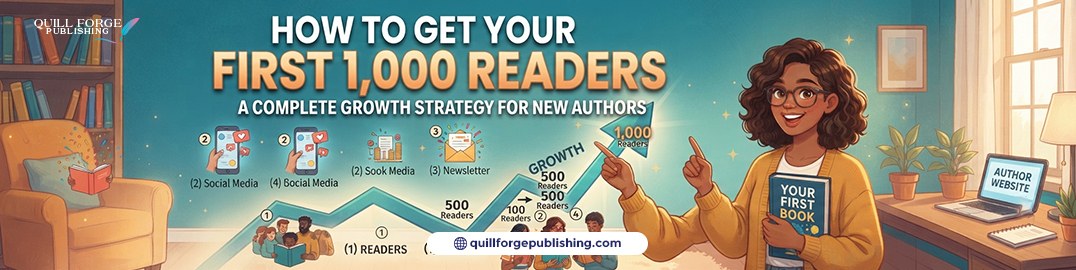
Getting your first 1,000 readers requires three things working together: a professionally produced book that earns positive reviews, a pre-launch platform that gives you an audience to launch to, and a sustained multi-channel marketing strategy that compounds over time.
The four phases of the strategy:
-
Phase 1: Foundation (3–6 months before launch) — author website, email list, ARC readers
-
Phase 2: Launch week — ARC review drops, Amazon Ads, email announcement, social campaign
-
Phase 3: Momentum (months 1–3) — sustained Amazon Ads, Goodreads, BookBub submission
-
Phase 4: Growth (months 3–12) — newsletter swaps, podcast appearances, community building
The fastest path to 1,000 readers: email list + Amazon Ads + ARC campaign + consistent Goodreads presence.
Every author who has ever published a book has faced the same moment: the book goes live, the launch announcement goes out, and then… mostly silence. A handful of sales from people who already know you. A trickle of reviews. The algorithm ignores you.
Getting your first 1,000 readers is the hardest milestone in an author's career not because it's complicated, but because it requires sustained effort across multiple channels simultaneously before any single channel has enough momentum to carry the load. This guide covers the complete author marketing services strategy for reaching that milestone: what channels actually work, in what order to build them, how Amazon book marketing fits into a broader plan, and what the best book marketing services focus on at every stage of the journey.
Key Takeaways
-
Your first 1,000 readers will not come from a single channel — they come from multiple overlapping efforts compounding over 6–12 months.
-
The email list is the most valuable asset you build — it's the only channel you own, with the highest conversion rate of any marketing touchpoint.
-
Amazon Ads capture readers who are already in buying mode — they're the highest-ROI paid channel for most genres, though it's worth knowing how to avoid wasting money on ads before you scale spend.
-
Launch-day reviews are the most important factor in the algorithm's initial assessment of your book — an ARC campaign is non-negotiable for a strong launch.
-
BookTok and Bookstagram move genre fiction. Podcast appearances and professional content move nonfiction and business books. Know which channel fits your genre.
-
The single most impactful thing you can do for your first book's marketing is start building your platform 6–12 months before publication, not the week before see when authors should actually start marketing their book.
What Book Marketing Services Channels Actually Get Authors to 1,000 Readers?
Not every marketing channel is equally effective for every author and every genre. Email list building and Amazon Ads form the backbone for most authors, but the strongest results come from layering in two or three additional channels chosen for your specific genre and reader:
-
Email list + newsletter — works for all genres, with the highest reader retention. Low cost, takes 3–6 months to build, medium effort.
-
Amazon Ads (AMS) — works for all genres by capturing buyers already in-market. Medium–high cost, results in days to weeks, needs ongoing optimisation.
-
BookTok / TikTok — best for genre fiction, especially romance, fantasy, and thriller. Free but time-intensive; results can be immediate if a video takes off. Read more on using BookTok for viral book promotion.
-
Bookstagram / Instagram — suits visual genres like children's books, literary fiction, and historical fiction. Free to low cost, 3–6 months to build momentum.
-
Goodreads — free, all genres, and compounds over time as a research-stage discovery channel.
-
ARC campaigns — low to medium cost, all genres, delivers a burst of reviews right at launch.
-
Podcast guest appearances — free, best for nonfiction, memoir, and business books, results in 1–3 months.
-
Author newsletter swaps — free, fiction-focused cross-promotion with immediate results at send.
-
BookBub featured deals — medium–high cost, massive reach across all genres once accepted.
-
Social media marketing for authors — free to low cost, all genres, but the slowest to compound (6–12 months). See the best platforms for organic book promotion this year for a genre-by-genre breakdown.
Spreading effort thinly across all channels is less effective than building genuine momentum on two or three well-chosen ones.
What Is the Right Book Launch Strategy for a New Author?
A book launch strategy for a new author has four distinct phases, each with different goals and primary actions. The biggest mistake new authors make is treating launch as a single event rather than a sustained campaign:
The authors who reach 1,000 readers fastest are the ones who treat Phase 1 foundation building — as seriously as launch week itself. A book launched to an email list of 500 engaged subscribers, 30 ARC reviewers ready to post, and an active Goodreads profile will always outperform the same book launched with none of those assets in place. Working through a self-publishing checklist before launch day helps make sure nothing in Phase 1 gets skipped.
How Does Building an Email List Help You Promote a Self Published Book?
Your email list is the only marketing asset you fully own. Social media platforms change their algorithms. Amazon changes its policies. Your email list belongs to you permanently, and it converts at rates that no social media channel can match. Average email open rates for author newsletters run 25–45%. Average organic social media reach is 2–6%.
For new authors learning how to promote a self published book, building an email list before launch is the single most impactful action you can take. Here is how to build it:
-
Set up your list immediately. Use ConvertKit, Mailchimp, or MailerLite. Even with zero subscribers, create the list, set up a signup page, and start pointing people to it from every public touchpoint.
-
Create a lead magnet. Give visitors a reason to subscribe beyond "sign up for updates." For fiction: a free prequel short story, bonus chapter, or exclusive worldbuilding content. For nonfiction: a free resource guide, checklist, or mini-course related to your book's subject.
-
Add a signup CTA to your book's backmatter. The last page of your book is the highest-converting email signup location available to you. Every reader who finishes your book and sees a compelling lead magnet offer has already proven they like your work.
-
Send consistently before you have anything to sell. A list that receives no emails for months loses engagement. Send at minimum once a month — a behind-the-scenes writing update, a reading recommendation, a short story. Readers should feel like they know you before the book launches.
How Does Amazon Book Marketing Work and Is It Worth It for New Authors?
Amazon Advertising (AMS) is the highest-ROI paid marketing channel for most self-published authors because it reaches readers who are already in buying mode. When a reader types "dark fantasy romance" or "leadership book for new managers" into Amazon's search bar, they are actively looking to buy. Your ad puts your book in front of that reader at the exact moment of purchase intent.
How Amazon book marketing through AMS works:
-
Sponsored Product Ads. Your book appears in Amazon search results and on competing book product pages. You bid on keywords (genre terms, comparable author names, specific search phrases) and pay per click.
-
Starting budget. $5–15/day is enough to test. Run ads for two to four weeks before evaluating results. Key metric: ACoS (Advertising Cost of Sale). A sustainable ACoS for most fiction is 30–50%; for nonfiction with a higher book price, 40–60% can still be profitable.
-
What makes Amazon Ads work. A strong, genre-clear cover design, 20+ reviews, and a competitive list price. Ads drive traffic; the cover, reviews, and description do the converting. Running ads before you have reviews is expensive and ineffective.
-
Comparable author targeting. Bid on the names of authors whose readers most closely match yours. A reader who loves a comparable author in your exact subgenre is your highest-value target.
What Are Book Publicity Services and When Do New Authors Need Them?
Book publicity services cover the professional PR side of author marketing: media outreach, press releases, podcast booking, review solicitation from credentialed sources, and placement in publications and media outlets. For most new authors building toward their first 1,000 readers, formal publicity is not the highest-priority investment — email, Amazon Ads, and ARC campaigns deliver better early ROI.
Book publicity services become most valuable when:
-
You're a nonfiction, business, or memoir author whose book has media relevance — a topic of current public interest, a compelling personal story, or professional credentials that make you a credible media commentator
-
You're launching with traditional or hybrid publishing support and a specific launch window where media coverage compounds
-
You have an existing public platform (podcast, blog, social following) that media appearances can amplify
-
Your book targets a professional or institutional audience (corporate buyers, library systems, academic adoptions) where professional PR opens doors that organic marketing cannot
For fiction authors building toward 1,000 readers, the time and budget allocated to formal publicity almost always delivers better results when redirected to ARC campaigns, BookBub submissions, and Amazon Ads.
What Does Social Media Marketing for Authors Actually Look Like in 2026?
Social media marketing for authors in 2026 has bifurcated sharply by genre. The platform that matters for your book depends almost entirely on what you write:
-
BookTok (TikTok). The dominant organic discovery channel for commercial fiction — especially romance (particularly dark romance and romantasy), fantasy, thriller, and young adult. A single video from a creator with 50,000 engaged genre followers can generate hundreds of Amazon sales in 48 hours. For fiction authors, sending review copies to genre-relevant TikTok creators is one of the highest-leverage actions available.
-
Bookstagram (Instagram). Strong for visually rich genres: literary fiction, children's books, historical fiction, and beautifully designed nonfiction. Slower organic growth than TikTok but more durable community building. Author Instagram accounts work best when they show the writing life, not just book covers.
-
LinkedIn. The primary social platform for business book authors, professional development nonfiction, and thought leadership titles. LinkedIn content that demonstrates expertise in your book's subject drives both book sales and consulting or speaking opportunities.
-
Facebook Groups. Most effective for finding ARC readers, running reader communities, and connecting with genre-specific book clubs. Less effective for organic discovery in 2026 than it was five years ago, but still valuable for community maintenance.
The most common social media mistake new authors make: trying to be present on every platform simultaneously with insufficient content for any of them. Two platforms with consistent, genre-appropriate content dramatically outperforms five platforms with sporadic activity.
How Does a Book Promotion Company USA Help New Authors Grow Their Readership?
A book promotion company USA or full-service publishing company with integrated marketing adds the most value for new authors who don't have the time or expertise to manage multiple marketing channels simultaneously. Here is what professional author marketing services from a book promotion company typically cover:
-
ARC campaign management. Setup and distribution of advance review copies through BookSirens, NetGalley, or BookFunnel; reader management; review tracking; follow-up.
-
Amazon Ads setup and management. Campaign structure, keyword research, bid management, and weekly performance reporting.
-
Email list setup and launch sequence automation. List configuration, lead magnet creation, welcome sequence, and launch announcement emails.
-
Social media content strategy. Content planning, caption writing, and posting strategy tailored to the author's specific genre and platform.
-
BookBub submissions and deal management. Preparing and submitting titles for BookBub featured deals — one of the highest-reach promotional mechanisms in indie publishing.
-
Media and podcast outreach. For nonfiction and memoir authors: media pitch writing, podcast booking, and press placement in genre-relevant publications.
If you're earlier in the process and still shaping the manuscript itself, working with a book coach alongside your marketing plan can make sure the book you're promoting is the strongest version of itself.
Have Questions About Book Marketing Services for Your First Book? Here's How to Get Clarity
Building a readership takes time, consistency, and the right channel mix for your specific genre and reader. If you're not sure where to focus first, what your launch strategy should look like, or how to set up Amazon Ads for your book, a free 30-minute consultation with the Quill Forge Publishing marketing team gives you a concrete, genre-specific action plan — no obligation.
-
ARC campaign management across BookSirens, NetGalley, and BookFunnel
-
Amazon Ads setup and management with weekly performance reporting
-
Email list setup and launch sequence automation
-
Social media content strategy tailored to your genre and platform
-
Full publishing services including editing, cover design, formatting, and global distribution
+1 (512) 380-1661 info@quillforgepublishing.com www.quillforgepublishing.com/book-marketing → Book a Free Marketing Consultation
Frequently Asked Questions:
1. How long does it take to get your first 1,000 readers?
For most new authors using a consistent multi-channel strategy, reaching 1,000 readers takes 6–12 months from publication. Authors who build their platform before launch (email list, ARC readers, social presence) can reach this milestone faster — sometimes within 3–6 months of publication. Authors who launch without any pre-existing platform typically take 12–18 months or more to reach 1,000 readers organically.
2. What are the most effective book marketing services for a debut author?
The highest-ROI book marketing services for a debut author are: an ARC campaign (20–50 reviews at launch dramatically improve algorithm performance and conversion), Amazon Ads (captures readers actively searching your genre), and email list building (the most durable long-term reader relationship channel). These three combined give you the strongest possible foundation for sustained readership growth beyond your immediate personal network.
3. How much should I spend on book marketing as a new author?
A realistic first-year marketing budget for a new author is 500–2,000,covering:ARCplatformfees(50–200),AmazonAds(150–500/monthtotestandscale),emailplatformsubscription(10–30/month), and potentially a BookBub featured deal (100–500+ depending on genre and price). The biggest variable is Amazon Ads — start small ($5–10/day), gather data for 3–4 weeks, then scale the campaigns that are converting at a sustainable ACoS.
4. How do I promote a self-published book without a big budget?
The most effective zero-budget tactics for how to promote a self published book: build your Goodreads author profile and list your book before launch; participate authentically in genre-specific Facebook groups and Reddit communities; reach out directly to 10–20 BookTok or Bookstagram creators in your genre with a free review copy; request backmatter review CTAs that convert readers into reviewers; and cross-promote with authors in your genre through newsletter swaps. None of these require a budget only consistent time investment.
5. What is a BookBub featured deal and is it worth it?
A BookBub featured deal is a promotional email sent to BookBub's subscriber list (segmented by genre) for a discounted or free book. It's one of the highest-reach promotional mechanisms in indie publishing — a single BookBub deal can generate thousands of downloads in 24 hours and significantly boost Amazon BSR and category placement. BookBub is competitive and selective: acceptance rates are low, especially for debut authors. Build your review count and sales history before applying. Cost ranges from $100 to $1,000+ depending on genre and list price.
6. Does social media marketing actually sell books?
Social media marketing for authors sells books indirectly for most genres — it builds awareness, reader community, and word-of-mouth that eventually converts to sales. The exception is BookTok for commercial genre fiction: creator recommendations on TikTok directly and measurably drive Amazon sales, often within hours of a video posting. For nonfiction, social media (especially LinkedIn and podcast appearances) builds professional authority that drives both book sales and business opportunities. For all genres, social media is most valuable as a long-term community-building channel, not a direct sales mechanism.
7. What is an ARC campaign and how does it help with the first 1,000 readers?
An ARC (Advance Review Copy) campaign sends pre-publication copies of your book to readers in exchange for honest reviews posted at launch. A book that launches with 20–50 reviews converts browsers to buyers at a dramatically higher rate than a book with zero reviews. It also signals quality to Amazon's recommendation algorithm during the critical launch window. ARC campaigns are run through platforms like BookSirens, NetGalley, and BookFunnel, typically 6–8 weeks before your publication date.
8. What is author marketing and how is it different from book marketing?
Author marketing services build your reputation, platform, and reader relationships across your entire publishing career — not just for a single title. Book marketing is title-specific: ads, ARC campaigns, and launch strategy for one book. Author marketing is career-wide: building your email list, social platform, media presence, and reader community in a way that makes every future book launch easier and larger than the last. Both are necessary — the most successful indie authors invest in both simultaneously.
9. How important are Amazon reviews for getting my first 1,000 readers?
Amazon reviews are critical. Ten reviews is the first meaningful threshold where Amazon's algorithm begins treating the book differently. Fifty reviews is where social proof becomes genuinely persuasive to browsers. One hundred reviews is where organic "also bought" placement and category bestseller tags begin to compound. Getting to 20–30 reviews at launch through an ARC campaign, and consistently accumulating reviews through backmatter CTAs and reader outreach, is one of the most important things you can do on the road to your first 1,000 readers.
10. Does Quill Forge Publishing offer book marketing and promotion services?
Yes. Quill Forge Publishing offers full book marketing services and author marketing services including ARC campaign management, Amazon Ads setup and management, email list setup and automation, social media content strategy, BookBub submissions, and launch strategy planning. We also offer full publishing services — editing, cover design, formatting, and global distribution — so your book is market-ready before marketing begins. Call +1 (512) 380-1661 or visit quillforgepublishing.com/book-marketing to discuss your book's marketing plan.