You’ve written a charming children’s story. The words flow beautifully. The concept is original. Then you start researching publication and discover that professional picture books are exactly 32 pages.
Always 32 pages.
This seems arbitrary until you understand the technical, economic, and design reasons behind this industry standard.
The 32-page rule isn’t a creative limitation. It’s a structural framework that professional children’s book publishing services follow because it works technically, economically, and creatively.
Understanding why 32 pages matters helps you craft stories that fit professional picture book formatting guidelines from the start, preventing costly restructuring later.
Why 32 Pages Is an Industry Standard
The 32-page format dominates children’s picture books for practical printing and binding reasons.
Picture books are printed on large sheets, then folded and bound into signatures. A signature is a collection of pages printed together on one sheet.
The math works like this:
One signature equals 16 pages (an 8-page spread front and back, folded).
Two signatures equal 32 pages total.
This configuration maximizes paper efficiency and minimizes printing costs for the trim sizes picture books typically use.
Deviating from 32 pages means either:
· Using half a signature (16 pages), which feels too short for most stories
· Adding another signature (48 pages), which significantly increases printing costs
Children’s book printing cost rises substantially when you move beyond standard configurations, making your book less competitive in pricing.
How the 32 Pages Actually Break Down
Not all 32 pages contain story content. Understanding the structure helps you plan your manuscript correctly.
Standard 32-page picture book breakdown:
Page 1: Half-title or endpaper
Pages 2-3: Title page spread or full title page and copyright
Page 4: Copyright, dedication, or blank
Pages 5-6: Story opening spread
Pages 7-30: Story content (24 pages of actual narrative)
Pages 31-32: About the author, publisher info, or final illustration
This means you’re actually working with approximately 12-13 double-page spreads for your story, not 16 full spreads.
Kids book layout services understand this structure and design accordingly, ensuring your story fits the format naturally.
Why Word Count Matters as Much as Page Count
The 32-page format dictates not just page quantity but also text volume per page.
Picture book word count guidelines:
Board books (ages 0-3): 0-100 words total
Picture books (ages 3-5): 400-600 words total
Picture books (ages 5-8): 600-1000 words total
Across 12-13 spreads, this means roughly 30-80 words per spread, sometimes fewer for pages that are primarily visual.
Exceeding these word counts creates design problems where text overwhelms illustrations or requires smaller fonts that young readers struggle with.
Self-publishing children’s books in the USA requires understanding these constraints before writing, not after your 2,000-word manuscript is complete.
How Illustration Space Affects Story Structure
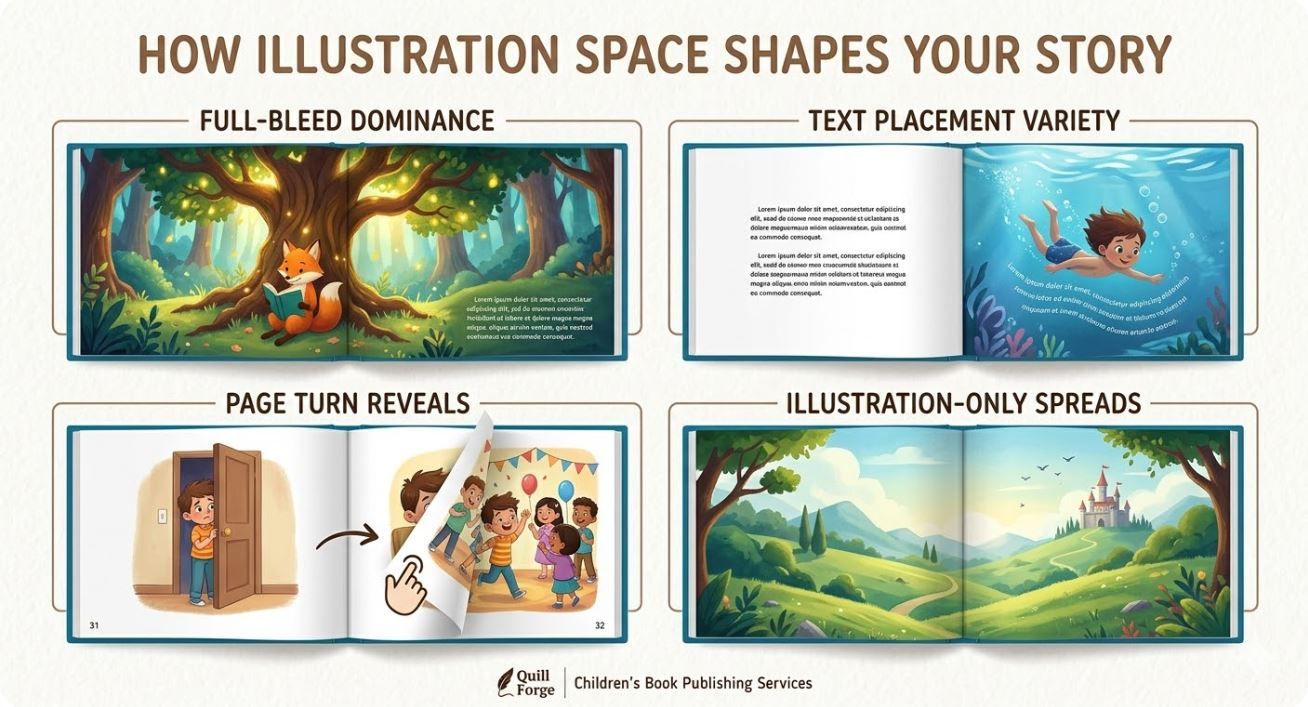
Picture books are visual storytelling. The 32-page format ensures adequate space for illustrations to breathe.
Professional picture book formatting guidelines recommend:
Spreads with minimal text allowing full-bleed illustrations to dominate certain moments.
Text placement variety sometimes on illustration, sometimes on white space, creating visual rhythm.
Page turn reveals where turning the page creates surprise or narrative advancement through visual change.
Illustration-only spreads where images tell the story without words.
Children’s book illustration services work within the 32-page structure to create pacing through visual variety, not just through text.
Stories that ignore this visual component and focus only on text rarely succeed as professional picture books.
Why Deviating from 32 Pages Creates Problems
Some authors insist their story requires 36 or 40 pages and that the market should accommodate creativity.
The practical problems with non-standard page counts:
Printing costs increase substantially, forcing higher retail prices that hurt competitiveness.
Retailer resistance as buyers prefer standard formats fitting established shelf systems.
Production complexity as fewer printers handle non-standard configurations.
Design challenges as the rhythm established by standard format gets disrupted.
Marketing difficulties positioning unusual formats against industry norms.
Professional children’s book publishing services guide authors toward standard formats for these practical reasons, not creative restriction.
How to Structure Your Story for 32 Pages
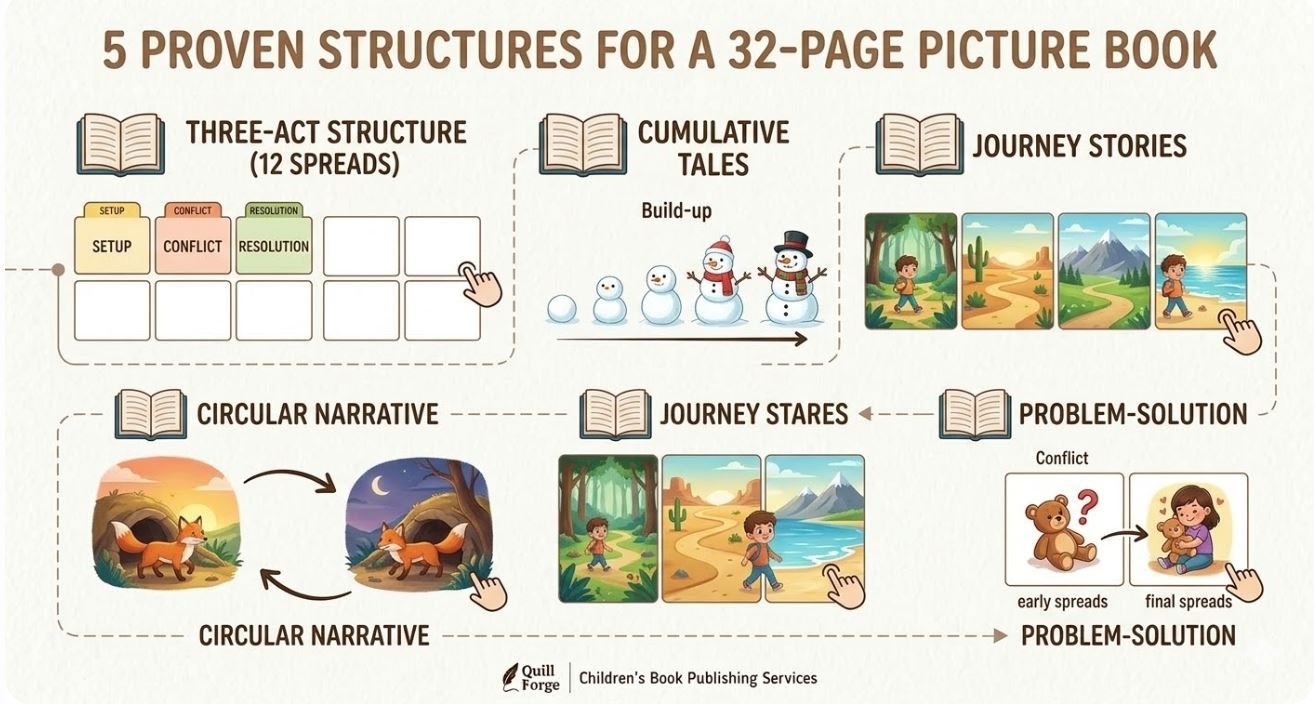
Writing specifically for the 32-page format from the beginning prevents painful revision later.
Structural approaches that work:
Three-act structure with setup, conflict, and resolution distributed across 12 spreads.
Circular narrative where ending echoes beginning, using structure to reinforce theme.
Cumulative tales building repetition across spreads toward satisfying conclusions.
Journey stories where each spread represents a location or step in progression.
Problem-solution introducing challenges early and resolving within page constraints.
Whatever structure you choose, outline your spreads before writing full text, ensuring your story arc fits the format naturally.
Why Professional Services Understand These Constraints
Attempting to self-publish a picture book without understanding industry standards leads to expensive mistakes.
Children’s book illustration services that specialize in picture books know:
· How to pace visual storytelling across standard page counts
· Where text should integrate with images versus stand separate
· Which spreads need full-bleed art versus contained illustrations
· How page turns create narrative momentum
Similarly, professional children’s book printing services optimize production for standard formats, offering better pricing and quality.
How Quill Forge Guides Picture Book Development
Creating professional picture books requires coordinating writing, illustration, design, and printing within industry-standard frameworks.
Quill Forge’s children’s book publishing services include:
Manuscript consultation helping authors structure stories for 32-page format before illustration begins.
Illustration coordination matching authors with illustrators who understand picture book pacing and visual storytelling.
Layout design creates spreads that balance text and image effectively across the standard format.
Print production through services optimized for 32-page picture book specifications.
Their team understands that the 32-page rule isn’t restriction but a professional framework enabling effective storytelling within established industry standards.
Why Exceptions Exist But Require Justification
Some successfully published picture books deviate from 32 pages. These exceptions prove the rule.
Non-standard page counts work when:
Established authors with proven sales history justify production investment in unusual formats.
Concept books where format itself is part of the creative concept require different structures.
Board books for youngest readers often use 16-24 pages with extremely limited text.
Novelty formats with special features, pop-ups, or interactive elements that demand different configurations.
For debut authors without established platforms, sticking to industry standards maximizes publication and sales opportunities.
How Page Count Affects Pricing and Profitability
The economics of picture book publishing directly relate to standard page counts.
Pricing considerations:
Production costs for 32-page books fall within the sweet spot for competitive retail pricing ($16-20).
Retailer margins work when wholesale discounts apply to reasonably priced books.
Parent budgets expect picture books in certain price ranges that 32 pages enables.
Author royalties remain viable when production costs don’t consume all margin.
Moving to 48 pages might increase production costs by 40-50%, forcing retail prices up to $25-28 where sales resistance increases significantly.
Start with Structure, Then Write
The 32-page picture book format exists for sound practical reasons that make production, distribution, and sales viable.
Understanding this framework before writing prevents frustration, wasted illustration investment, and unmarketable manuscripts.
Your story deserves a professional structure that positions it competitively in established markets where readers, retailers, and libraries know what to expect.
Ready to create a professionally structured picture book?
Book your free consultation with Quill Forge today and start your publishing journey with children’s book services that understand industry standards and guide you toward marketable, professional results.
Frequently Asked Questions
1. Can my picture book be 24 or 40 pages instead of 32?
Technically yes, but 24 feels too short for most stories and 40 significantly increases costs. Industry standards exist for good economic and design reasons.
2. How many words should my 32-page picture book contain?
Typically 400-1000 words total depending on target age. Younger audiences need fewer words; older picture book readers can handle slightly more text.
3. Do I count the title page and copyright in my 32 pages?
Yes. The 32 pages include all pages from front to back, including title, copyright, and end matter. Story content fills roughly 24-26 of those pages.
4. Can I write the story first and fit it to 32 pages later?
Possible but inefficient. Better to structure for 32 pages from the start, preventing major rewrites when text doesn’t fit the format.
5. Does the 32-page rule apply to early readers and chapter books?
No. This rule is specific to picture books. Early readers and chapter books follow different formatting conventions based on their formats.
6. How much does it cost to print a 32-page picture book?
Print-on-demand costs $5-8 per book. Offset printing at 500-1000 copies reduces per-unit cost to $3-5 depending on specifications.
7. Do I need to hire an illustrator before knowing my page count?
No. Finalize your story structure and page breakdown first, then work with illustrators who understand what’s needed for each spread.
8. Can digital picture books have different page counts?
Digital formats offer more flexibility, but maintaining standard structure helps if you later want print editions.
9. How does Quill Forge help with picture book structure?
Quill Forge’s children’s book services include manuscript consultation ensuring your story fits industry-standard format before illustration and design begin.
10. What if my story naturally falls at 28 or 36 pages?
Work with professional editors or coaches to restructure for 32 pages. Stories that seem to require odd counts usually benefit from tightening or slight expansion.