If you've finished your manuscript and you're wondering what happens next specifically, what it's going to cost you're asking exactly the right question. Publishing a book in the UK in 2026 is more accessible than it has ever been, but accessible doesn't mean free. And the range of costs can vary so dramatically that without a clear breakdown, it's easy to either overspend on services you don't need or underspend on ones that genuinely matter.
This guide gives you a straightforward, honest picture of what UK book publishing costs in 2026 — across every route, every service, and every budget level.
The Three Publishing Routes (and What Each Costs You)
Before we talk numbers, it's important to understand that the route you choose shapes everything. In the UK publishing landscape today, authors have three main paths available to them.
1. Traditional Publishing — Little to No Upfront Cost
Traditional publishing through an established UK publishing house means the publisher covers all production, editing, design, and distribution costs. You pay nothing upfront. In return, you receive an advance against royalties — though for debut authors, advances can be modest — and you typically earn between 10% and 15% of the book's retail price.
The trade-off is significant: you surrender a degree of creative control, you'll likely need a literary agent (who takes 15% of your UK royalties), and the timeline from submission to publication can stretch to 18 months or more. For many first-time authors, traditional publishing remains highly competitive, with publishers receiving hundreds of submissions daily and accepting only a fraction.
2. Self-Publishing — You Fund, You Own
Self-publishing puts you fully in control. You commission all services independently, retain all creative rights, and keep a much larger share of royalties — typically between 35% and 70% of the retail price, depending on the platform. The cost falls entirely on you.
In the UK, most authors who self-publish spend somewhere between £500 and £5,000, depending on the services they invest in and the quality level they're aiming for. A realistic mid-range budget for a professionally produced paperback and eBook sits around £1,500 to £2,500.
3. Hybrid Publishing — Shared Investment, Shared Support
Hybrid publishing sits between the two. You pay for professional services — editing, design, printing, distribution — but benefit from the structure and guidance of a publishing team. Costs vary widely. A reputable UK hybrid publisher may charge anywhere from £1,500 to £5,000+ for a full package.
A word of caution: the term "hybrid publisher" is used loosely in the industry. Always compare the services and fees offered against what you would pay sourcing each service independently before signing any agreement.
Breaking Down the Real Costs: Service by Service
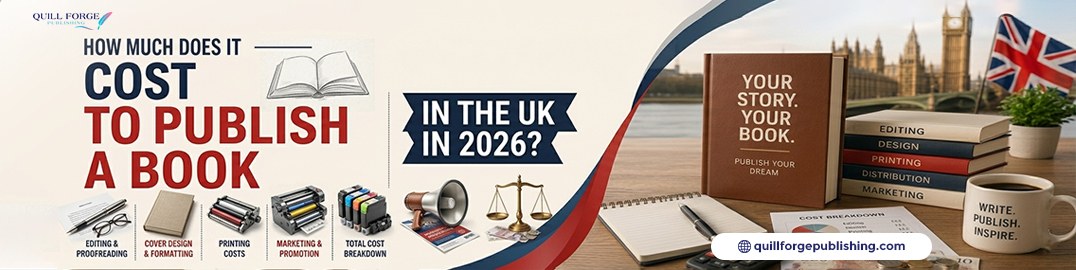
Whether you self-publish or work with a hybrid publisher, the same core services are involved. Here is what each one genuinely costs in the UK in 2026.
Editing
Editing is consistently the largest single expense in the self-publishing process — and the one place where cutting corners costs you most in the long run. A poorly edited book shows, and readers notice.
There are three main types of editing, each with a different scope and price point:
-
Developmental Editing — addresses big-picture structure, pacing, character, and argument. For an 80,000-word manuscript, expect to pay between £2,400 and £4,800 based on current CIEP (Chartered Institute of Editing and Proofreading) 2026 suggested rates.
-
Copy Editing — covers grammar, consistency, syntax, and style. Typical rates run from £1,280 to £2,400 for a full-length novel.
-
Proofreading — the final pass over typeset pages, catching any remaining typos or formatting errors. Budget around £640 to £1,200.
For authors on tighter budgets, a professional copy edit and proofread — skipping the full developmental edit — is a common and sensible approach, especially for manuscripts that have already been through multiple drafts. On average, a 300-page book can be professionally edited and proofread for around £300 to £800 at the more accessible end of the market.
Cover Design
Readers absolutely do judge a book by its cover, and in an online marketplace where your thumbnail competes with hundreds of others, a professional design is not optional — it's a commercial strategy.
In the UK:
-
Premade covers typically cost between £50 and £150 — a viable option for authors on a tight budget, though less bespoke.
-
Custom cover design from a professional designer ranges from £200 for a clean, straightforward design to £1,500 or more for fully custom illustrated artwork.
For most authors, a custom cover designed specifically for their genre and readership sits somewhere between £300 and £600.
Formatting and Typesetting
Your manuscript needs to be properly formatted before it can be printed or distributed digitally. This is often underestimated in budget planning.
Professional formatting and typesetting in the UK typically costs between £100 and £600, depending on the complexity of the book a straightforward novel sits at the lower end, while a non-fiction book with images, tables, and footnotes will cost more.
It is worth noting that free formatting tools are available (Reedsy's book editor and similar platforms) for authors comfortable managing the process themselves.
ISBN Registration
An ISBN (International Standard Book Number) is essential if you want your book stocked in UK bookshops or listed with major retailers. In the UK, ISBNs are issued through Nielsen and cost £89 for a single ISBN — notably more expensive than in some other countries, where they are available free of charge.
If you are publishing in multiple formats (paperback, hardback, eBook, audiobook), each format requires a separate ISBN. Buying a block of 10 ISBNs reduces the per-unit cost significantly.
Some self-publishing platforms, such as Amazon KDP and IngramSpark, offer free ISBNs — but using a platform-assigned ISBN limits your ability to distribute through other channels independently.
Printing
If you are producing a print book, you have two main options: print-on-demand (POD) or an upfront print run.
With print-on-demand, each copy is printed when a reader places an order. There are no upfront printing costs — the production cost is simply deducted from the sale price. This is the most common and practical approach for independent UK authors today.
For those who want physical stock from the outset — say, for events, bookshop submissions, or personal distribution — an initial run of 200 copies of a standard 300-page paperback with cover design and distribution set-up through a UK publisher typically comes to around £2,500, according to figures from Troubador Publishing.
Marketing
Marketing is where many first-time authors underestimate both the importance and the cost. A book without visibility doesn't sell, regardless of its quality.
Basic self-promotion through social media and organic content costs nothing but time. A more structured approach — including a book launch campaign, advance review copies, paid advertising, or PR outreach — can cost anywhere from £300 to several thousand pounds, depending on how far you want to take it.
What Does It All Add Up To?
Here is an honest summary of total costs across three budget levels for a typical self-published UK author in 2026:
What Affects the Price Most?
Several factors will push your costs up or down, and it's worth understanding them before you commit to a budget:
Word count is the primary driver of editing costs. A 60,000-word novel will cost considerably less to edit than a 120,000-word historical saga.
Genre influences cover design pricing. Illustrated fantasy covers or highly detailed non-fiction layouts require more specialist design work.
Format matters too. Publishing simultaneously as a paperback, hardback, eBook, and audiobook multiplies several costs ISBNs, formatting, and distribution set-up in particular.
VAT is worth noting for UK authors. Most freelance editors and designers operate below the £90,000 VAT registration threshold and will not charge VAT. However, VAT-registered providers add 20% to their fees, and Nielsen ISBNs already include VAT in their listed price.
Where Does a Professional Book Publishing Service Fit In?
For many UK authors — particularly those writing their first book the most practical approach is working with a dedicated book publishing service that handles the coordination of these services on your behalf.
Rather than sourcing an editor, a designer, a formatter, and a distributor independently (which is time-consuming and requires a degree of industry knowledge to navigate well), a professional publishing service brings those elements together under one roof. This gives you quality control, a consistent production process, and the confidence that every stage of your manuscript's journey is being managed by people who understand what UK readers, retailers, and distributors expect.
The right publishing partner is not the cheapest option on the market it's the one that delivers genuine value at every stage, from manuscript to bookshelf.
Final Thoughts
Publishing a book in the UK in 2026 is a real investment — in time, in craft, and in professional services. The costs are real, but so is the return when your book reaches readers in the form it deserves.
Whether you are budgeting £500 or £5,000, the principle is the same: spend wisely on the services that matter most, and don't cut corners where quality is visible to your reader.
If you're ready to take the next step and would like to understand what our publishing packages include and how they're priced, we'd be glad to walk you through the options.
Looking for a trusted UK book publishing service? Get in touch with our team today to discuss your manuscript and find the right publishing route for your goals.